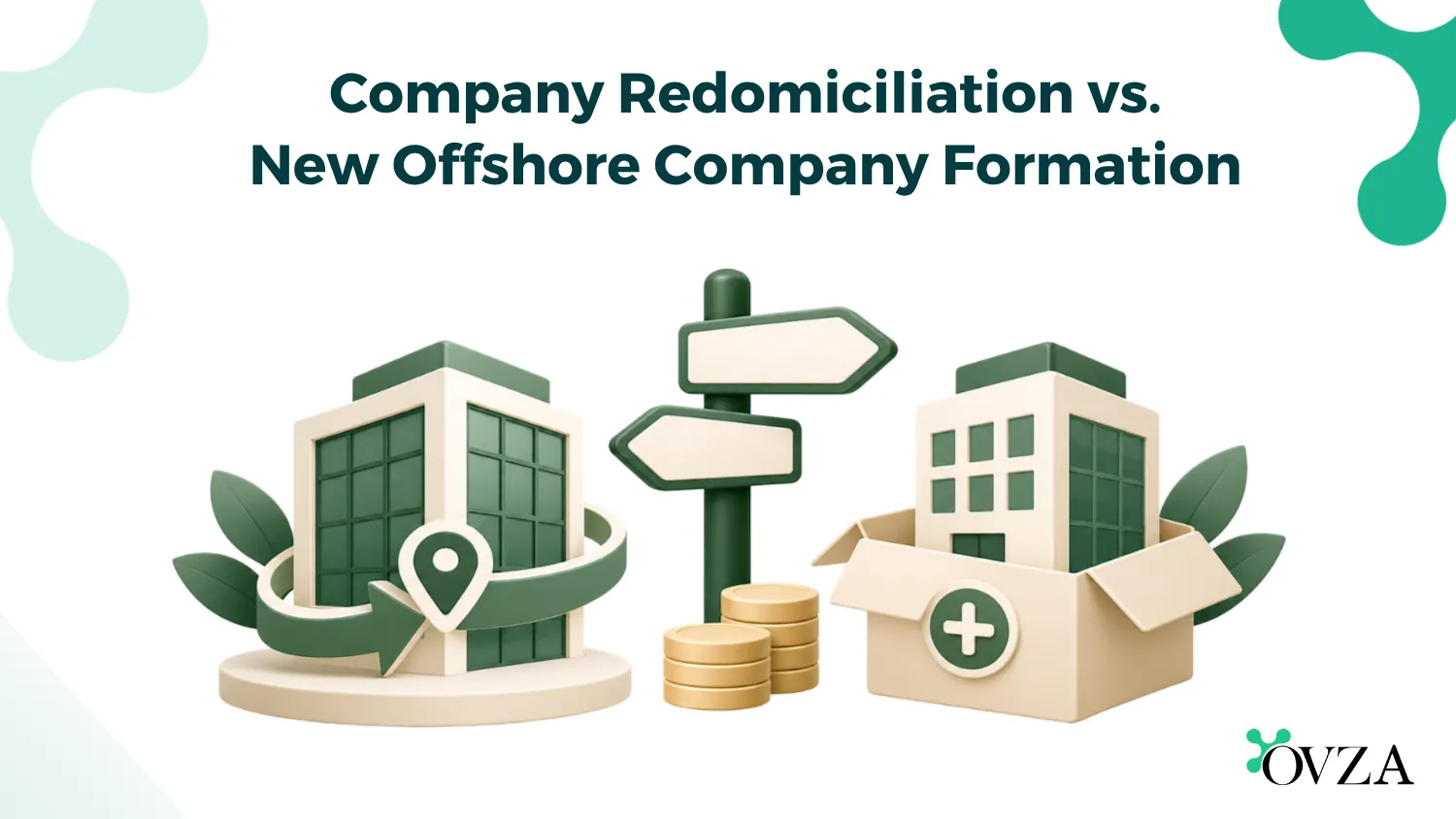
When structuring or relocating an international enterprise across offshore financial centers, corporate counsel and business principals must choose between two primary legal mechanisms: corporate redomiciliation (statutorily termed corporate continuation) and new company formation. Although both pathways result in an active corporate vehicle registered under the laws of an offshore jurisdiction, they operate on fundamentally different principles of private international law.
New company formation is the creation of a brand-new legal person (persona ficta) from inception. Upon filing constitutional documents with the host corporate registrar, the entity receives a new registration number, a new incorporation date, and an unencumbered balance sheet. It possesses no prior legal history, commercial liabilities, or pre-existing contractual relationships. Where a founder already operates an existing company in another jurisdiction, establishing a new offshore company leaves the original entity intact as a separate legal person unless separate steps are taken to wind it up or convert it into a parent or subsidiary.
Corporate redomiciliation, by contrast, relies on the conflict-of-laws doctrine of continuous legal personality. Rather than dissolving an existing company and incorporating a replacement, statutory continuation permits an incorporated entity to transfer its statutory seat, registered office, and governing corporate law (lex societatis) from one jurisdiction to another without undergoing liquidation. The underlying corporate entity never ceases to exist; instead, the self-same legal person continues its corporate life seamlessly under the companies statute of the incoming jurisdiction, retaining its original founding date, equity structure, and historical track record.
- Operational Continuity: Contracts, Assets, and Corporate Vintage
- Banking Onboarding, KYC Compliance, and Payment Rails
- Statutory Eligibility, Bilateral Consent, and Procedural Timelines
- Comparative Matrix: Offshore Redomiciliation vs. New Company Formation
- Strategic Selection: Determining the Appropriate Structuring Route
- Conclusion
Operational Continuity: Contracts, Assets, and Corporate Vintage
The practical divergence between redomiciliation and fresh incorporation becomes most apparent when migrating an active business with established commercial relationships, balance-sheet assets, or intellectual property.
Attempting to relocate an operating enterprise through new company formation requires executing a formal cross-border asset transfer. Every existing client agreement, vendor contract, software license, and commercial lease must be formally assigned or novated from the legacy entity to the newly incorporated offshore company. Contractual novation requires the affirmative written consent of third-party counterparties, exposing the business to administrative delays, unwanted fee renegotiations, or contract terminations. Simultaneously, transferring real estate titles, subsidiary shareholdings, or registered intellectual property portfolios between two distinct legal entities requires formal deeds of conveyance and may trigger capital gains assessments, stamp duties, or property transfer taxes in the departing territory.
Statutory redomiciliation eliminates these transactional disruptions by operation of law. Because the continuing company remains the identical legal person that originally executed its commercial agreements, no assignment or novation is required unless a specific contract contains an explicit covenant restricting a change of corporate domicile.
All property, investment accounts, choses in action, and intellectual property priority dates remain vested in the continuing corporation without a transfer of title. Equally important, the incoming registrar issues a Certificate of Continuation recording both the date of migration and the company’s original date of incorporation, allowing the enterprise to preserve its established operational vintage and commercial credit rating.
Banking Onboarding, KYC Compliance, and Payment Rails
In modern cross-border commerce, banking accessibility often dictates the viability of a corporate restructuring. Under heightened global Anti-Money Laundering (AML) and Know Your Customer (KYC) standards, opening tier-one corporate bank accounts and securing international merchant acquiring facilities for a newly incorporated offshore company requires comprehensive due diligence from zero. Because a newly formed entity has no audited financial history, banking compliance committees scrutinize projected transaction flows, source of wealth documentation, and commercial substance before approving accounts, often resulting in extended onboarding timelines.
Redomiciliation substantially reduces this banking friction when the existing entity already maintains established financial relationships. Because the underlying legal person does not dissolve, existing corporate bank accounts and payment processing gateways generally remain open throughout the transition. Once continuation is finalized, the company updates its institutional banking profile by submitting certified copies of its Certificate of Continuation, newly adopted Memorandum and Articles of Association, and a current Certificate of Incumbency. Financial institutions treat the migration as an administrative jurisdiction update for an existing vetted client, preserving multi-currency clearing rails, Legal Entity Identifier (LEI) records, and historical merchant dispute metrics.
Statutory Eligibility, Bilateral Consent, and Procedural Timelines
While redomiciliation offers superior continuity for established enterprises, new company formation provides unmatched procedural speed and universal availability.
Incorporating a new offshore company is a unilateral administrative process governed solely by the laws of the chosen destination. Provided the beneficial owners satisfy the licensed registered agent’s due diligence checks and the proposed corporate name is available, formation in leading centers such as the British Virgin Islands, Seychelles, Nevis, or the Cayman Islands is routinely completed within one to two business days. There is no dependency on foreign registries, no requirement to obtain tax clearances from another state, and no statutory waiting period.
By contrast, corporate redomiciliation is a bilateral statutory procedure that depends on legal compatibility between two sovereign jurisdictions. For a cross-border continuation to proceed, the corporate legislation of the departing jurisdiction must expressly authorize outbound discontinuance, and the corporate legislation of the receiving jurisdiction must authorize inbound continuation. While premier offshore centers maintain reciprocal continuation frameworks, several onshore jurisdictions and specialized corporate registries either prohibit outbound migration or restrict it to narrow regulatory approvals.
Furthermore, executing a redomiciliation requires confirming Good Standing in the exporting registry, passing shareholder special resolutions, executing director declarations of solvency, and satisfying statutory creditor notice periods extending the timeline from several weeks to a few months depending on the registries involved.
Comparative Matrix: Offshore Redomiciliation vs. New Company Formation
| Structural Dimension | Corporate Redomiciliation (Continuation) | New Company Formation (Fresh Setup) |
| Legal Identity | Preserves continuous legal personality, original incorporation date, and corporate history. | Creates a brand-new legal person (persona ficta) with a new registration number and start date. |
| Jurisdictional Eligibility | Bilateral; requires statutory continuation laws in both departing and incoming jurisdictions. | Unilateral; governed solely by the incorporation laws of the destination jurisdiction. |
| Contracts & Assets | Survive automatically by operation of law; no novation or title conveyance required. | Require formal assignment, counterparty consent, and asset transfer agreements. |
| Banking & Payment Rails | Existing accounts and merchant profiles generally remain active via compliance updates. | Requires full KYC onboarding from inception to establish new banking and merchant facilities. |
| Pre-Existing Liabilities | All historical debts, obligations, and litigation follow the company into the new domicile. | Isolated from legacy entities; starts with a clean balance sheet and zero historical liabilities. |
| Execution Timeline | Multi-week to multi-month process depending on Good Standing clearances and creditor notices. | Rapid execution, typically completed within 24 to 48 hours upon KYC clearance. |
Strategic Selection: Determining the Appropriate Structuring Route
Selecting between redomiciliation and new company formation depends on the maturity of the enterprise, the nature of its balance sheet, and the statutory rules of its current domicile.
New company formation is the optimal mechanism for greenfield ventures, newly launched international trading lines, and asset-ring-fencing strategies. When an established onshore group wishes to isolate a high-risk commercial division, launch a standalone intellectual property holding subsidiary, or form a joint venture with outside equity partners, incorporating a fresh offshore vehicle ensures complete legal separation from legacy liabilities. Fresh incorporation is also the necessary alternative where an existing company is domiciled in a jurisdiction whose domestic corporate law prohibits outbound redomiciliation.
Corporate redomiciliation is the superior strategic choice for established operating entities, investment holding companies, and family offices seeking to upgrade their governing jurisdiction without operational interruption. Enterprises frequently utilize continuation when shifting economic substance mandates make their current domicile impractical, when correspondent banking friction affects their existing flag, or when institutional investors require governance under a recognized common-law statute such as the BVI Business Companies Act or the Cayman Islands Companies Act. By migrating the existing entity rather than starting anew, leadership preserves decades of commercial goodwill, protects tax-neutral asset continuity, and maintains uninterrupted treasury operations.
Conclusion
Whether an international structuring mandate calls for incorporating a new offshore vehicle or synchronizing a cross-border corporate continuation, disciplined legal and fiduciary execution is essential. Improperly executed asset transfers between a legacy company and a newly formed offshore entity can trigger unintended exit taxes or breach commercial covenants, while an uncoordinated redomiciliation risks administrative holds if registry filings fall out of sequence.
Working alongside experienced offshore corporate fiduciaries ensures that statutory eligibility is verified prior to filing, constitutional documents are drafted to meet institutional banking standards, and all Good Standing certificates, solvency declarations, and board resolutions are executed in strict compliance with local company law.

Add OVZA to Google Preferred Sources
Make OVZA your preferred source to ensure you can easily discover our latest insights, research, and trusted content directly through Google.

Disclaimer: The information provided on this website is intended for general reference and educational purposes only. While OVZA makes every effort to ensure accuracy and timeliness, the content should not be considered legal, financial, or tax advice.