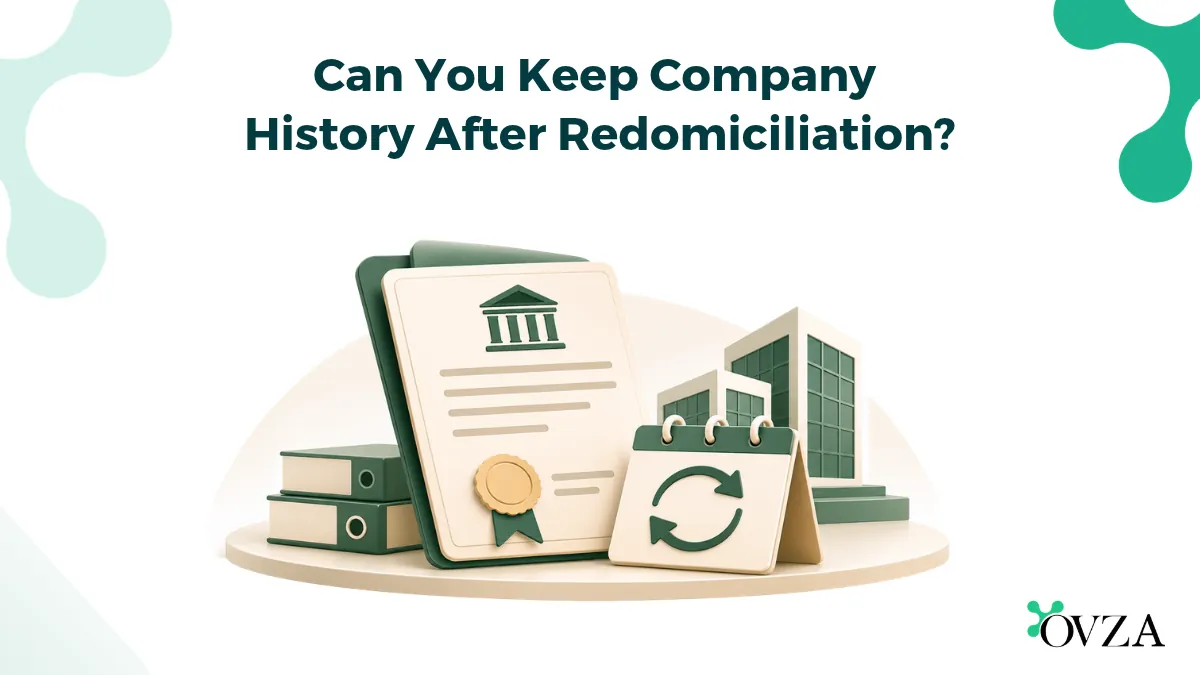
A company that completes a statutory redomiciliation known across common-law corporate statutes as corporate continuation fully retains its company history. The entity preserves its original date of incorporation, historical accounting ledgers, audited performance records, commercial credit ratings, and operational vintage.
This preservation is anchored in private international law under the doctrine of continuous legal personality. In cross-border corporate jurisprudence, an incorporated entity is governed by its lex societatis the domestic company law of the jurisdiction in which it is chartered. Historically, under a strict territorial view of corporate law, an entity was treated as a legal creation belonging exclusively to the sovereign state that registered it. Relocating a business abroad traditionally meant placing the original company into formal liquidation, winding up its affairs, and incorporating an entirely new foreign legal person (persona ficta). That obsolete procedure broke the corporate lifespan, severed commercial agreements, forced the novation of banking facilities, and frequently triggered taxable capital gains or stamp duties.
Modern statutory redomiciliation frameworks create a legal bridge between sovereign company registries. Corporate continuation allows an existing entity to transfer its statutory seat, registered office, and governing corporate law to a new jurisdiction without undergoing liquidation or dissolution. The company does not cease to exist for a single moment, nor does the migration give birth to a successor entity. Instead, the self-same corporate person continues its unbroken existence under the company laws of the new host jurisdiction, keeping its foundational history, commercial goodwill, and legal standing fully intact.
Statutory Mechanics of Preserving Corporate Age and Country of Origin
The retention of an entity’s original incorporation date and historical origin is explicitly protected by modern company law. When a company migrates into a premier international financial center, the receiving corporate registrar does not issue a standard Certificate of Incorporation. Instead, the registrar issues a statutory Certificate of Continuation.
This certificate confirms the entity’s unbroken lineage by recording two distinct legal dates directly on the public registry: the date on which the company continued into the new territory, and the original, historical date on which the business was formed in its former country of origin.
For example, under Section 184 of the British Virgin Islands Business Companies Act, 2004 (as amended), the statute dictates that when a foreign company continues into the territory, it continues as a company under the Act without any alteration in its underlying legal status. The BVI Registrar of Corporate Affairs explicitly registers the entity’s original incorporation date and prior jurisdiction, giving constructive legal notice that the company is the self-same legal person that historically operated abroad. Parallel statutory guarantees are codified under Part XII of the Cayman Islands Companies Act (As Revised), Section 388 of the Delaware General Corporation Law (DGCL § 388), and the corporate statutes of Nevis and the Cook Islands.
This statutory preservation of corporate age is a vital commercial asset. Credit rating bureaus, commercial landlords, maritime classification registries, and government procurement portals assess counterparty stability through operational age. By preserving its founding year, a continued company demonstrates decades of verifiable institutional tenure rather than presenting itself as an unproven day-one startup. Furthermore, because the company is the identical legal person that operated historically, its multi-year audited financial statements, historical revenue numbers, and corporate tax records remain valid and unified across subsequent reporting periods.
Contractual Continuity, Choses in Action, and Undivided Asset Ownership
A primary operational hazard of dissolving an entity and re-incorporating is the disruption of its lex contractus the governing law of its active commercial agreements. When a business transfers its operations to a newly formed company, every commercial contract must be formally assigned or novated. This process requires the affirmative consent of every counterparty, providing clients, landlords, and suppliers with an opportunity to renegotiate commercial pricing, demand stricter covenants, or terminate relationships outright.
Statutory redomiciliation eliminates the requirement for contractual novation because the contracting legal party never changes. By operation of law, the migrating company remains the identical corporate party that executed the original agreements. Master services agreements, enterprise software licenses, international distribution networks, and commercial leases remain active and enforceable in accordance with their original terms. Unless an agreement contains a specific restrictive covenant that defines a cross-border change of corporate domicile as an event of default, the business continues its operations without transactional interruption.
The same unbroken continuity protects company assets, capital capitalization, and intellectual property. Statutory continuation frameworks universally provide that upon the issuance of the Certificate of Continuation:
- All property, real and personal, and all choses in action (including rights to legal claims, uncollected debts, and contractual rights) remain vested in the continued company without requiring deeds of assignment.
- All real estate titles, investment accounts, subsidiary shares, and global patent and trademark portfolios remain titled in the name of the continuing corporation without triggering title conveyance fees or property transfer taxes.
- Intellectual property priority dates filed with national and international patent and trademark authorities such as the USPTO, EUIPO, and WIPO remain undisturbed because legal title never transferred to a third party.
- The company remains liable for all its pre-existing debts, liabilities, and statutory obligations. Section 184 of the BVI BCA, along with equivalent provisions in the Cayman Islands and Delaware, expressly confirms that no conviction, judgment, ruling, debt, or liability is impaired by continuation. Ongoing legal claims by or against the company continue without abatement.
Banking Relationships, KYC Profiles, and Merchant Processing
Maintaining uninterrupted treasury accounts is critical during international restructuring. Establishing cross-border corporate bank accounts and securing international payment processing facilities for newly formed entities has become an intensive, documentation-heavy undertaking under modern Anti-Money Laundering (AML) and Know Your Customer (KYC) standards. Winding down an established company to form a new one resets this compliance process, frequently resulting in frozen merchant processing rails and delayed supplier payments.
Corporate redomiciliation resolves this operational hurdle by preserving established banking relationships. When a business completes its continuation, institutional banks and payment processors (such as Stripe, Adyen, and regional merchant acquirers) treat the transition as an administrative corporate profile update rather than the onboarding of an unvetted client. The entity retains its original Legal Entity Identifier (LEI) profile, updating only the jurisdictional data fields to reflect its new registered office.
To update its banking mandates, the company provides its financial institutions with a certified compliance package:
- The certified Certificate of Continuation issued by the incoming registrar, confirming the original incorporation date and current registration details.
- The replacement constitutional documents (such as the newly adopted Memorandum and Articles of Association or Articles of Continuance) drafted to comply with the new corporate statute.
- An updated Certificate of Incumbency issued by the licensed registered agent detailing the current board of directors, officers, and beneficial owners.
- A formal Board Resolution passed by the directors confirming the successful continuation and authorizing the maintenance of existing banking mandates and signatory powers.
Because the underlying legal entity is unchanged, the company retains its historical corporate credit history, its operational dispute-rate track record with credit card networks, and its existing multi-currency payment rails, ensuring continuous revenue collection throughout the transition.
Bilateral Procedural Synchronization: Outbound Discontinuance and Inbound Continuance
Successfully maintaining company history through redomiciliation requires careful corporate secretarial coordination between the departing jurisdiction and the incoming destination. The migration functions as a dual-statutory procedure: the corporate laws of both jurisdictions must contain reciprocal statutory provisions that permit cross-border continuation.
The legal migration proceeds through two synchronized phases:
Phase One: Outbound Clearance and Discontinuance
The process commences in the departing jurisdiction. Corporate directors must establish that the company is in Good Standing, that all government registry fees are settled, and that no regulatory investigations are underway. The board of directors typically executes a statutory Declaration of Solvency, swearing that the company is solvent, capable of paying its debts as they fall due, and that the migration will not prejudice the claims of existing creditors. The company secures shareholder approval (routinely requiring a 75% special resolution) and, where required by local statute, publishes a formal notice in the government gazette to allow outstanding creditors an opportunity to register claims.
Phase Two: Inbound Continuance and Registration
Simultaneously, the company’s legal counsel files an application for continuation with the corporate registrar in the destination jurisdiction. This application includes the company’s historical charter, certified shareholder resolutions, and replacement constitutional documents drafted to comply with the incoming territory’s company laws.
Once satisfied, the destination registrar issues the Certificate of Continuation. This document is submitted back to the departing registry, which issues a Certificate of Discontinuance and strikes the entity from its domestic register as a continuing entity rather than a dissolved one. The legal life of the corporation flows from one jurisdiction to the other without a single moment of legal interruption.
Conclusion
Corporate redomiciliation is an indispensable governance mechanism for multinational enterprises, private investment funds, and family offices. It allows a business to migrate its legal home in response to shifting economic substance mandates, geopolitical changes, or unfavorable tax legislation, while fully preserving its historical foundation.
By relying on statutory continuation rather than liquidation, an established enterprise preserves the commercial vintage of its original founding date, maintains its existing agreements without costly novations, and keeps its corporate banking rails active. Executed correctly, redomiciliation provides a seamless transition that updates the company’s governing jurisdiction while protecting its hard-earned corporate heritage.
Managing cross-border corporate migrations, solvency declarations, and multi-jurisdictional filings requires experienced offshore legal coordination. Professional fiduciaries ensure that statutory filings are synchronized between corporate registries, that company records remain in Good Standing, and that banking partners receive the certified instruments required to keep financial operations moving without delay.

Add OVZA to Google Preferred Sources
Make OVZA your preferred source to ensure you can easily discover our latest insights, research, and trusted content directly through Google.

Disclaimer: The information provided on this website is intended for general reference and educational purposes only. While OVZA makes every effort to ensure accuracy and timeliness, the content should not be considered legal, financial, or tax advice.