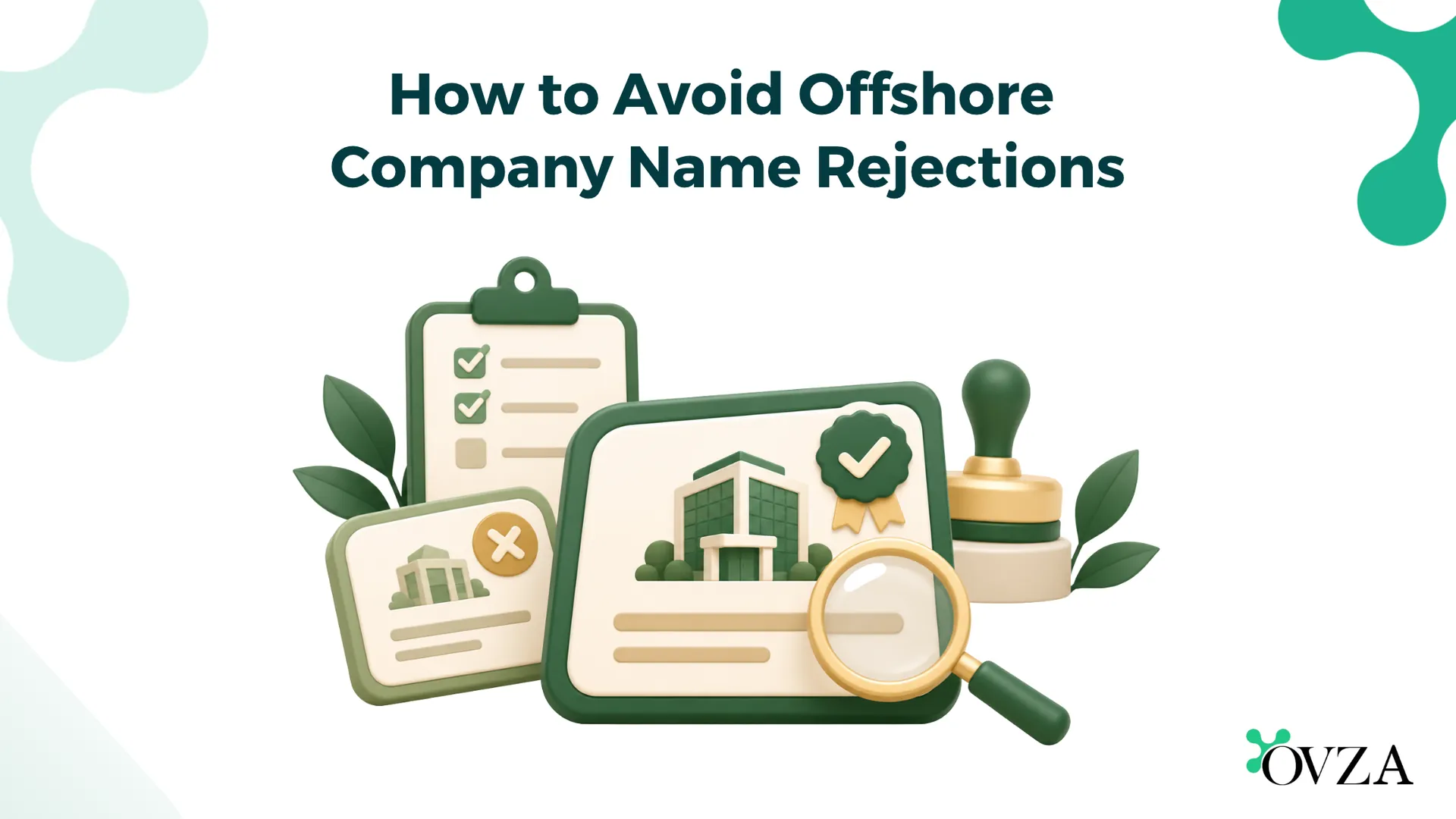
Securing approval for a proposed corporate name is the first substantive regulatory gate in any offshore incorporation or corporate redomiciliation. Although digital filing portals allow licensed registered agents to submit incorporation packages within hours, an unvetted company name frequently triggers immediate administrative rejection, stalling entity formation, delaying banking onboarding, and forcing costly amendments to draft constitutional documents.
Corporate registrars across international financial centers including the British Virgin Islands Registry of Corporate Affairs, the Cayman Islands General Registry, the Seychelles Financial Services Authority, and the Belize Companies and Corporate Affairs Registry evaluate name applications against strict statutory criteria. These rules are designed to prevent public deception, protect existing commercial goodwill, preserve sovereign symbols, and ensure that unregulated entities do not imply licensed financial status. Understanding these clearance standards before submitting an application allows corporate counsel and founders to secure first-time approval without procedural friction.
Identical and Confusingly Similar Name Conflicts
The most common ground for administrative rejection is conflict with an existing name on the corporate register. Under modern offshore companies statutes such as Section 17 of the BVI Business Companies Act, 2004 (as amended) and Section 30 of the Cayman Islands Companies Act (As Revised) a registrar will refuse to register a name that is identical to, or so nearly resembles, the name of an existing company, limited partnership, or reserved name that it is likely to confuse or mislead the public.
Crucially, corporate registries apply phonetic and visual similarity tests rather than relying solely on exact spelling matches. Registrars routinely disregard corporate suffixes (such as “Limited,” “Corp.,” or “Inc.”), punctuation marks, spacing, capitalization, and generic connective words like “The,” “And,” or “International” when comparing proposed names against the active index. Consequently, attempting to register “Apex Global Holdings Limited” when “Apex Holdings Corp.” already exists on the register will almost certainly result in rejection.
Similarly, adding purely descriptive geographic or industry modifiers such as inserting “Offshore,” “Ventures,” “Group,” or “Capital” rarely overcomes a conflict with an established root name unless the applicant holds formal written consent from the existing company demonstrating a group affiliate relationship. Even where an existing company has been struck off the register, most jurisdictions enforce a statutory cooling-off period of several years during which the defunct name remains blocked from re-use to prevent third parties from hijacking a struck-off entity’s commercial identity while restoration remains legally possible.
Restricted, Sensitive, and Regulated Words
Every offshore jurisdiction maintains a statutory schedule of restricted and prohibited terms that cannot be included in a company name without prior regulatory clearance or supporting documentation. Attempting to incorporate a standard holding or trading company using regulated terminology is a guaranteed trigger for rejection.
The strictest category involves financial and fiduciary terminology. Words such as Bank, Banking, Trust, Trustee, Insurance, Assurance, Reinsurance, Fund, Mutual Fund, Asset Management, Securities, Exchange, and Clearing are heavily protected across all reputable offshore hubs. Registrars prohibit their use unless the applicant simultaneously applies for or already holds a formal financial services license from the domestic regulator, such as the Cayman Islands Monetary Authority (CIMA) or the BVI Financial Services Commission (FSC).
A second category covers sovereign, governmental, and institutional terms. Words implying royal patronage, state sponsorship, or official status including Royal, Imperial, Government, National, Federal, Municipal, Chartered, Chamber of Commerce, and Authority are rejected unless backed by explicit governmental or royal consent. Similarly, terms suggesting academic, professional, or charitable accreditation such as University, College, Institute, Foundation, or Association frequently require proof of non-profit status, educational accreditation, or specialized entity structuring.
Trademark Infringement and Passing-Off Risks
Passing a preliminary corporate registry index check does not insulate a proposed name from rejection if it infringes upon globally recognized intellectual property. Corporate registrars retain broad statutory discretion to refuse any name they consider undesirable, offensive, or likely to facilitate passing off.
If a proposed offshore company name incorporates a famous international brand, registered trademark, or well-known financial institution even if no identically named entity currently sits on that specific offshore registry the registrar will reject the application to protect the jurisdiction’s international compliance reputation. Even where an automated registry system inadvertently permits a trademark-infringing name to pass initial registration, offshore statutes empower the registrar to issue a compulsory direction compelling the company to change its name within a short statutory window upon receiving a third-party trademark objection, forcing expensive re-papering of bank accounts and commercial contracts.
Foreign-Language Characters, Dual-Language Names, and Transliteration
International clients frequently seek to incorporate offshore entities using non-Latin scripts, most commonly Chinese characters alongside an English corporate name. Leading jurisdictions such as the British Virgin Islands, the Cayman Islands, and Seychelles expressly permit dual-language corporate names, provided strict procedural rules are observed.
To avoid rejection of a foreign-language name, the applicant must submit a certified translation and transliteration prepared by a qualified translator confirming the exact meaning of the non-Latin characters. Registrars reject foreign-character names if the translation contains restricted financial words, offensive meanings, or fails to correspond accurately to the English version of the name. Furthermore, formatting errors such as placing foreign characters inside a standard English-only name field rather than utilizing the registry’s designated dual-name filing schedule frequently cause automated portal rejections.
Conclusion
Selecting and clearing an offshore company name is a foundational compliance step that impacts not only registry approval, but also institutional bank onboarding and cross-border trademark protection. Banks routinely reject account applications where a company’s registered name implies regulated financial activity that contradicts its actual commercial business plan, even if the registrar permitted the name.
Coordinating name clearance checks, statutory reservations, dual-language translations, and constitutional drafting with experienced offshore corporate fiduciaries ensures smooth first-time registration and prevents costly post-incorporation name changes.

Add OVZA to Google Preferred Sources
Make OVZA your preferred source to ensure you can easily discover our latest insights, research, and trusted content directly through Google.

Disclaimer: The information provided on this website is intended for general reference and educational purposes only. While OVZA makes every effort to ensure accuracy and timeliness, the content should not be considered legal, financial, or tax advice.