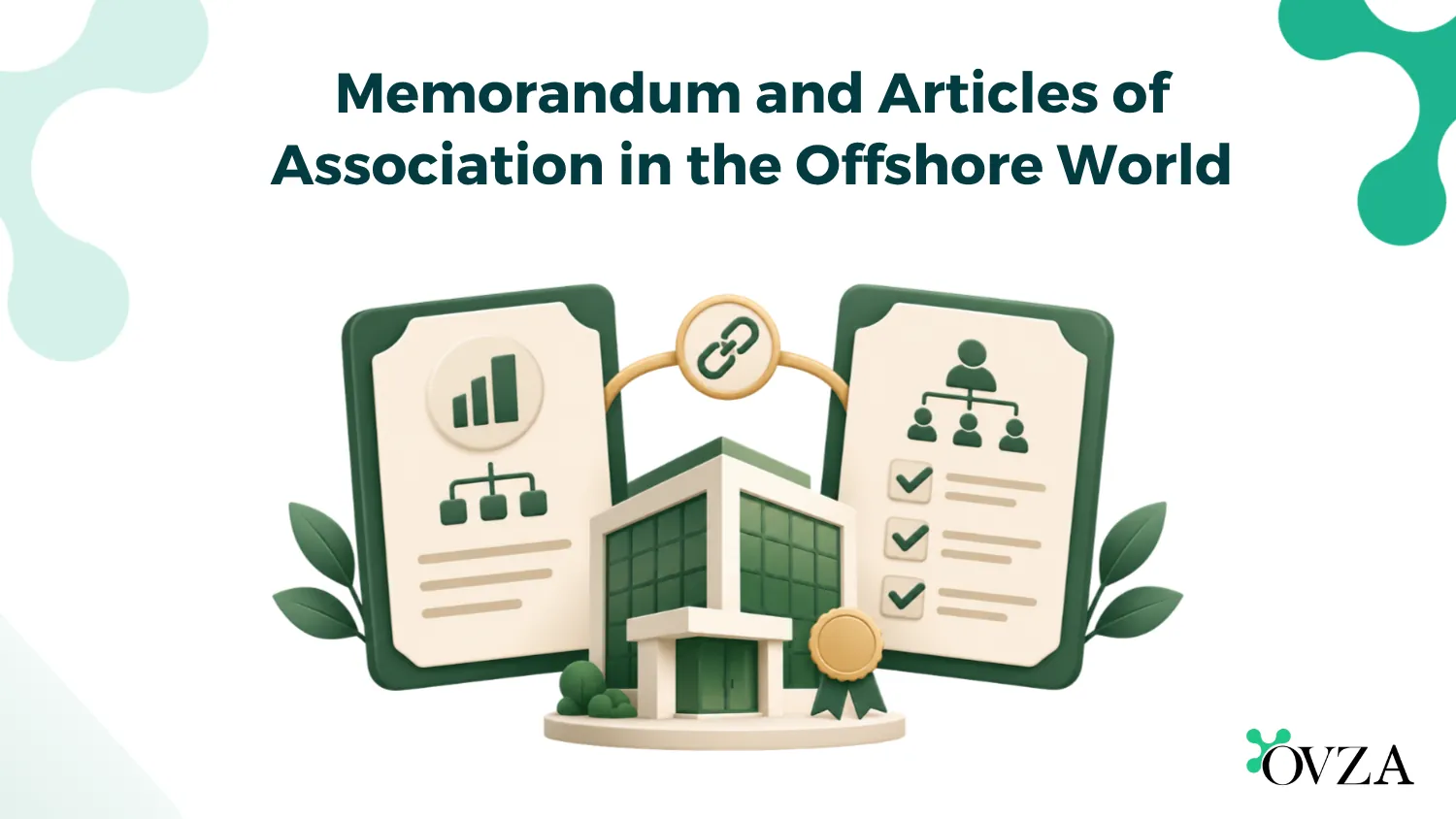
In common-law offshore financial centers including the British Virgin Islands, the Cayman Islands, Seychelles, and Belize the constitutional charter of an incorporated company is divided into two distinct yet interrelated legal instruments: the Memorandum of Association (MOA) and the Articles of Association (AOA). Collectively referred to in corporate practice as the “M&A” or the company’s constitution, these documents form the foundational legal skeleton of the entity upon registration.
Under English common-law corporate jurisprudence, which underpins the statutory frameworks of most international financial centers, the registered Memorandum and Articles operate as a statutory contract. For instance, Section 11 of the BVI Business Companies Act, 2004 (as amended) expressly codifies that the Memorandum and Articles bind the company and each member (shareholder) to the same extent as if each member had executed them under seal, while simultaneously creating binding obligations between the members themselves.
Understanding the precise legal division between external corporate capacity and internal governance is essential for corporate counsel, fiduciaries, and international founders. While off-the-shelf standard templates suffice for basic single-member holding vehicles, multi-shareholder joint ventures, investment funds, and family offices rely on bespoke M&A drafting to allocate voting power, restrict share transfers, and satisfy institutional banking compliance.
- The Memorandum of Association (MOA): Corporate Identity and External Capacity
- The Articles of Association (AOA): Internal Management and Governance
- Comparative Statutory Frameworks Across Offshore Jurisdictions
- Banking Compliance, KYC Scrutiny, and Commercial Execution
- Bespoke Drafting, Entrenchment, and Constitutional Amendments
- Conclusion
The Memorandum of Association (MOA): Corporate Identity and External Capacity
The Memorandum of Association serves as the company’s external charter, defining its legal identity, capitalization parameters, and relationship with the outside world. Executed at formation by the initial subscriber typically the licensed resident registered agent acting on the instructions of the beneficial owners the Memorandum establishes the non-negotiable statutory facts required by the corporate registrar to issue a Certificate of Incorporation.
Under modern offshore statutes such as Section 9 of the BVI Business Companies Act, every Memorandum must state the exact legal name of the company, its corporate classification (such as a company limited by shares, a company limited by guarantee, an unlimited company, a restricted purposes company, or a segregated portfolio company), the address of its first registered office, and the name of its first registered agent. For entities authorized to issue shares, the Memorandum must also specify the maximum number of shares the company may issue or state that it is authorized to issue an unlimited number of shares alongside the designations, powers, preferences, and qualifications of each share class or series.
Historically, common-law Memoranda included exhaustive “objects clauses” detailing every commercial activity the company was permitted to pursue, under the strict common-law ultra vires doctrine that rendered any transaction outside those stated objects void. Modern offshore legislation has largely abolished the ultra vires trap for standard commercial entities. Under Section 28 of the BVI Business Companies Act and Section 27 of the Cayman Islands Companies Act (As Revised), an unrestricted company possesses full legal capacity to carry on any lawful business or activity anywhere in the world, regardless of whether specific commercial objects are enumerated in its Memorandum. Restrictive objects clauses are now reserved almost exclusively for specialized vehicles such as securitization SPVs or Restricted Purposes Companies where creditors or rating agencies legally require the entity’s activities to be ring-fenced to a single transaction.
The Articles of Association (AOA): Internal Management and Governance
Where the Memorandum defines what the company is, the Articles of Association prescribe the internal rulebook governing how the company operates. Subordinate to the Memorandum and the overriding mandatory provisions of the host jurisdiction’s companies statute, the Articles regulate the internal mechanics between the board of directors, corporate officers, and shareholders.
In many offshore jurisdictions, corporate statutes provide a baseline set of default governance rules traditionally modeled on “Table A” in the Cayman Islands Companies Act or the statutory default provisions of the BVI Business Companies Act which automatically apply unless expressly modified or excluded by the company’s filed Articles. In fact, under Section 10 of the BVI Business Companies Act, the statute mandates only a single compulsory clause within the Articles of a company limited by shares: a statement specifying the circumstances in which share certificates shall be issued.
Beyond that baseline, customized Articles govern the operational lifeblood of the corporation. They establish procedures for convening general meetings, setting quorum thresholds, executing written resolutions in lieu of physical meetings, and exercising voting rights. They also define the appointment, removal, fiduciary duties, and indemnification of directors, alongside the board’s authority to issue new shares, declare dividends, approve share transfers, adopt a corporate seal, and initiate voluntary liquidation.
Comparative Statutory Frameworks Across Offshore Jurisdictions
Although the dual MOA and AOA framework is a hallmark of Commonwealth offshore jurisdictions, statutory treatment regarding public disclosure, default rules, and alternative entity forms varies significantly across international financial centers.
| Jurisdiction & Governing Statute | Constitutional Documents | Public Registry Inspection | Key Statutory Features |
| British Virgin Islands (BVI Business Companies Act, 2004) | Memorandum & Articles of Association | Public; filed M&A is open to public inspection at the Registry. | Supports unlimited authorized shares, Section 12 entrenching clauses, and Restated M&As. |
| Cayman Islands (Companies Act, As Revised) | Memorandum & Articles of Association | Private; filed with the Registrar but not open to general public inspection. | Relies on Table A default articles unless disapplied; requires a 2/3 special resolution for amendments. |
| Seychelles (International Business Companies Act, 2016) | Memorandum & Articles of Association | Private; maintained on file with the Registrar without public access. | Flexible par-value or no-par-value share structures; modern electronic execution rules. |
| Nevis & Cook Islands (Offshore LLC Ordinances) | Articles of Organization & Operating Agreement | Private; only brief Articles of Organization are filed publicly. | US-style LLC governance; internal rules reside in a private contract (Operating Agreement) rather than AOA. |
As illustrated above, confidentiality rules represent a critical distinction for private clients. In the British Virgin Islands, the up-to-date Memorandum and Articles are placed on the public register and can be inspected by third parties conducting corporate searches a key reason why BVI practitioners avoid placing sensitive family names or commercial pricing formulas inside the filed Articles, relegating those terms to a private Shareholders’ Agreement instead. Conversely, in the Cayman Islands and Seychelles, the filed M&A remains confidential from general public inspection. Furthermore, where an offshore structure utilizes a Limited Liability Company (LLC) in Nevis or the Cook Islands or a civil-law Private Interest Foundation in Panama the common-law MOA and AOA are replaced by Articles of Organization paired with a private Operating Agreement, or a Foundation Charter paired with private Regulations.
Banking Compliance, KYC Scrutiny, and Commercial Execution
In modern international commerce, an offshore company’s Memorandum and Articles are scrutinized just as closely by institutional banking compliance officers as they are by corporate registrars. During Know Your Customer (KYC) and Anti-Money Laundering (AML) onboarding, tier-one international banks, private wealth custodians, and merchant acquiring processors examine certified copies of the M&A to verify legal capacity and signatory authority.
Compliance teams review the Memorandum first to confirm that the entity is legally permitted to engage in its stated business activities and to verify that the charter expressly prohibits the issuance of bearer shares, a legacy instrument abolished across reputable offshore centers due to global financial transparency mandates. Simultaneously, bank legal counsel examines the Articles of Association to confirm board quorum rules, director appointment mechanics, and execution formalities. If the Articles require two directors to form a quorum or mandate the affixing of a physical corporate seal to execute binding deeds, a bank will reject account-opening resolutions signed by a sole director without a seal.
Similarly, international counterparties and cross-border lenders rely on the M&A when issuing legal opinions. Before extending credit facilities to an offshore holding company, lender’s counsel conducts a constitutional review to ensure the board possesses express borrowing powers, authority to grant security over corporate assets, and unencumbered power to register share charges without triggering pre-emption blocks in the Articles.
Bespoke Drafting, Entrenchment, and Constitutional Amendments
While standard registered-agent templates are adequate for wholly owned subsidiaries, sophisticated multi-party transactions require bespoke constitutional engineering. In joint ventures, venture capital holding vehicles, and multi-generational family offices, corporate counsel routinely customizes the Articles to embed different classes of shares such as Class A voting management shares and Class B non-voting economic shares alongside drag-along rights, tag-along protections, compulsory transfer triggers, and weighted board voting rules.
Embedding critical governance protections directly into the Articles of Association provides a powerful legal remedy that a standalone Shareholders’ Agreement cannot match. Because a Shareholders’ Agreement is a private contract, a breach typically entitles the aggrieved party only to contractual damages or equitable injunctions. By contrast, an act taken by directors in violation of the Articles of Association is constitutionally defective and susceptible to being declared ultra vires or void ab initio by the offshore court. To prevent majority shareholders from unilaterally stripping minority protections, statutes such as Section 12 of the BVI Business Companies Act permit entrenching provisions within the Memorandum or Articles, stipulating that designated clauses cannot be amended at all or may only be altered by a supermajority threshold or upon the fulfillment of specific conditions.
When corporate growth, restructuring, or new investment rounds require updating the company’s constitution, amendments must follow strict statutory formalities. Depending on the jurisdiction and the specific charter terms, amendments are passed by a resolution of members (such as a two-thirds special resolution in the Cayman Islands) or, where expressly authorized by the Memorandum, by a resolution of directors. Crucially, in jurisdictions such as the BVI, an amendment to the Memorandum or Articles has no legal effect until a notice of amendment or a consolidated Restated Memorandum and Articles of Association is formally registered with the Registrar of Corporate Affairs.
Conclusion
An offshore company’s Memorandum and Articles of Association are far more than routine incorporation paperwork; they are the primary legal instruments defining corporate authority, shareholder rights, and institutional credibility. Drafting these documents with precision at formation prevents costly governance deadlocks, streamlines institutional bank onboarding, and ensures seamless alignment with cross-border tax and regulatory mandates.
Coordinating bespoke constitutional drafting, statutory registry filings, and certified corporate document packages requires experienced offshore fiduciary oversight. Working alongside qualified corporate services professionals ensures that your Memorandum and Articles accurately reflect your commercial structure, remain properly updated through restated filings when amended, and satisfy the compliance standards of global banking partners.

Add OVZA to Google Preferred Sources
Make OVZA your preferred source to ensure you can easily discover our latest insights, research, and trusted content directly through Google.

Disclaimer: The information provided on this website is intended for general reference and educational purposes only. While OVZA makes every effort to ensure accuracy and timeliness, the content should not be considered legal, financial, or tax advice.