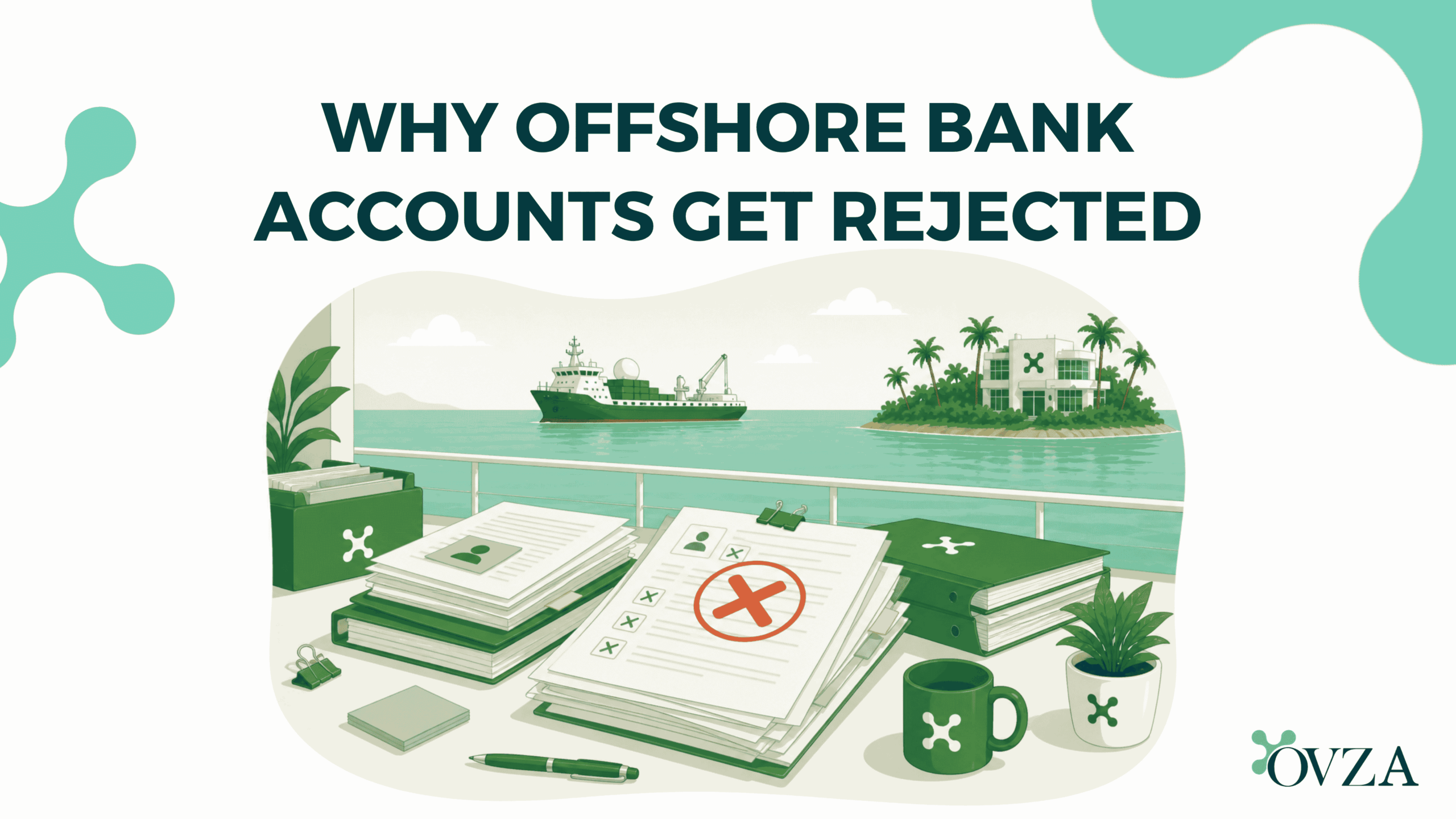
In the fiscal landscape of 2026, the era of “easy” offshore banking has officially ended. Global financial institutions, pressured by the 2026 AMLA Guidelines and ISO 20022 data standards, have shifted from a “Yes, until proven otherwise” stance to a “De-risking by Default” strategy.
Today, a rejected application is rarely about the legitimacy of your business; it is about the “Compliance Effort” required to manage you. If a bank’s AI-driven monitoring system cannot categorize your revenue flow in seconds, you are a liability. Understanding why these rejections happen is the only way to secure a seat in the global financial system.
Why “Source of Wealth” Matters More Than Your Balance
One of the most frequent reasons for application failure is that applicants often conflate their current liquid capital with their comprehensive wealth history. In the regulatory climate of 2026, providing a simple bank statement showing a high balance for a deposit is no longer sufficient. Modern compliance officers and automated risk-assessment engines demand to see the “why” and the “how” behind every dollar.
You must be prepared to reconstruct a longitudinal narrative of your financial life. This involves producing a robust paper trail that typically spans the last five to ten years. Banks now scrutinize audited business financial statements, detailed tax filings from your primary jurisdiction of residence, and legal documents such as inheritance certificates, property sale deeds, or dividend distribution records. Without this historical corroboration, banks view the capital as “Unexplained Wealth,” triggering a mandatory rejection under 2026 AMLA protocols. In essence, your wealth must have a clear, documented genealogy before it can be integrated into the formal global banking system.
The Problem with “Mismatched” Business Structures
If your company is registered in the Seychelles, your suppliers are based in Vietnam, and your customers are primarily in the United States, you are operating in what compliance officers call a “mismatched corridor.” In the eyes of a bank’s automated flagging system, this isn’t just a complex supply chain; it’s a glaring red flag for money laundering. The days when you could set up an offshore entity “just because” or for vague tax optimization are long gone. Today, banks aren’t just looking for your paperwork; they are looking for your “Substance Narrative.”
A Substance Narrative is the human story that explains why your business exists where it does. It’s the bridge between a legal registration and commercial reality. Compliance teams are increasingly skeptical of “letterbox companies” that have zero physical footprint in their jurisdiction of incorporation. If you can’t prove that your business actually *functions* in the places you claim, a bank will likely view you as a high-risk shell entity and issue an immediate rejection.
To justify a mismatched structure, you need to provide concrete, physical proof of operational reality. This goes beyond a basic utility bill. We’re talking about evidence that shows real humans are doing real work. For example, if you claim logistical efficiency in a specific hub, the bank will want to see local employment contracts, photos of a physical office space (not a co-working desk), or even specialized equipment leases. If your structure is built around territorial tax benefits, you must demonstrate that the management and control of the company the actual decision-making is happening within that jurisdiction.
Think of it as showing your work in a math problem. If you have a BVI holding company, why? Is it because your lead investors require a stable, English Common Law framework for their protection? If so, show the investor agreements. If you have a tech team in Eastern Europe, show the local payroll tax filings. Banks want to see that your geographic footprint makes sense from a business standpoint, not just a tax-avoidance one. Ultimately, they are looking for a commercial logic that a human can understand and verify, ensuring that your global setup isn’t just a digital ghost, but a tangible, functioning enterprise.
They aren’t just looking for bad news; they’re looking for consistency. A LinkedIn profile that contradicts your business history or a missing corporate email address can be enough to trigger a fraud alert. Consistency is key: your website, professional profiles, and email setup should all validate the claims made in your application.
Structural Complexity vs. UBO Transparency
While using multiple layers of holding companies such as a Nevis Trust owning a BVI entity remains a legal way to manage assets, it now triggers significant hurdles. To save on administrative costs, many banks will reflexively decline applications if they can’t identify the Ultimate Beneficial Owner (UBO) within the first two layers of the corporate structure.
To avoid an automatic “no,” you should provide a signed Group Structure Chart that clearly identifies anyone with more than 10% ownership. In today’s banking climate, being transparent with the bank is actually the best way to protect your privacy from the general public.
Strategic Comparison: 2026 Banking Standards
| 2026 Friction Point | Why Banks Reject | How to Secure Approval |
| Identity Proof | Low-quality or expired scans | Notarised / Biometric Verified ID |
| Business Logic | “General Trading” descriptions | Niche, Mapped Revenue Narratives |
| Tax Status | No Tax ID (TIN) provided | Mandatory TIN (e.g., Seychelles) |
| Financial History | Recent statements only | 3-Year “Wealth Root” Audit |
| Communication | Personal/Free email (Gmail) | Verified Institutional Email |
How to Avoid the “Compliance No”
Success in 2026 offshore banking requires “Pre-Compliance.” At OVZA, we recommend a three-step protocol before submitting any application:
- The TIN Verification: Never apply without a Tax Identification Number. As seen in the Seychelles 2026 mandate, a TIN is the “Golden Ticket” that tells a bank you are a legitimate taxpayer.
- The “One-Page” Summary: Provide a one-page executive summary of your business model, including your expected monthly volume, top 3 jurisdictions for inflows, and top 3 for outflows.
- Document Notarisation: Ensure all identity documents are notarised or apostilled according to the Hague Convention standards. A non-notarised ID in 2026 is an automatic “Return to Sender.”
Conclusion
Offshore bank rejections in 2026 are rarely a judgment on your character; they are a response to a lack of data. By treating compliance as an operational asset rather than a hurdle you align your business with the bank’s internal risk appetite. In a world of automated “No,” a clean, transparent, and notarised application is the only way to get a “Yes.”
Disclaimer: The information provided on this website is intended for general reference and educational purposes only. While OVZA makes every effort to ensure accuracy and timeliness, the content should not be considered legal, financial, or tax advice.