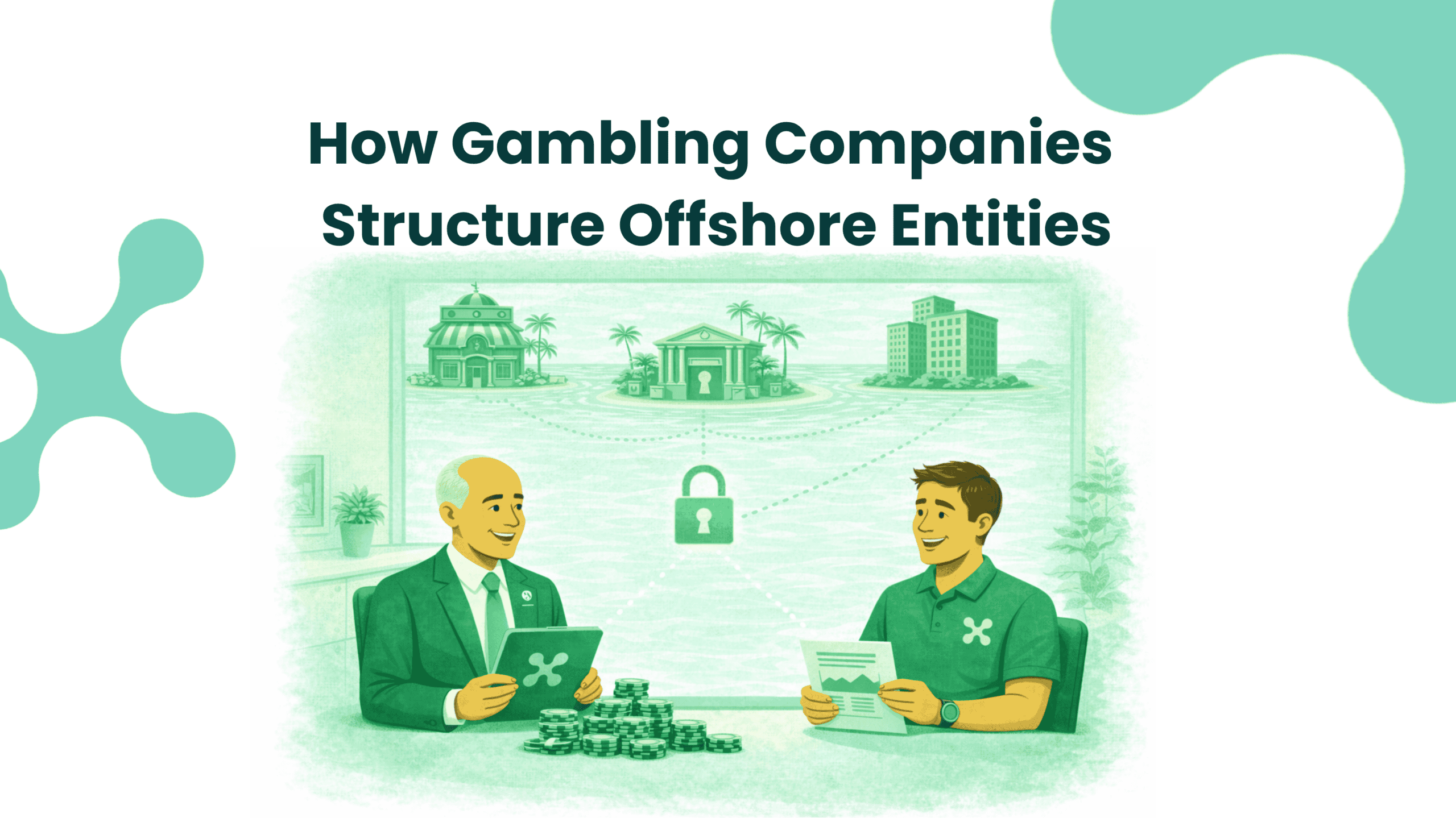
Offshore gambling structures are commonly used by international operators to legally separate incorporation, licensing, and operational activities across multiple jurisdictions, allowing for flexibility, asset protection, and tax neutrality.
The online gambling industry is one of the clearest examples of how offshore company structuring is applied in practice rather than theory. Unlike traditional businesses, which typically operate within a single legal system, gambling companies are almost always built across multiple jurisdictions. This is not merely for tax efficiency, but rather a necessity driven by licensing restrictions, payment processing limitations, and the inherently cross-border nature of online gaming platforms.
At its core, a typical offshore gambling structure involves at least two key components:
- a corporate entity formed in a flexible offshore jurisdiction, and
- a separate licensing framework obtained from a jurisdiction that permits online gambling activities.
These components may exist within a single entity or be separated across multiple entities depending on the operator’s scale, but the principle remains consistent.
The Legal Separation Between Incorporation and Licensing
A fundamental principle in understanding how gambling companies use offshore structures in practice is the distinction between the place of incorporation and the place of licensing. This distinction is often misunderstood by new operators, yet it is one of the most critical elements of a functioning structure.
Incorporation refers to the legal formation of the company itself. This determines where the company exists as a legal person, where its internal governance is defined, and under which corporate laws it operates. Licensing, on the other hand, governs the activity of gambling, specifically, the legal authorization to offer betting, gaming, or wagering services to users.
There is no legal requirement for these two elements to exist within the same jurisdiction. In fact, in many cases, separating them is preferable. Jurisdictions that offer flexible and cost-effective incorporation options often do not provide gambling licenses, while jurisdictions that provide licensing may impose higher costs or operational restrictions if used as the base company jurisdiction.
This separation allows gambling companies to optimize their structure. The incorporation jurisdiction can be selected based on efficiency and flexibility, while the licensing jurisdiction is selected based on regulatory recognition and accessibility.
The Role of Offshore Incorporation Jurisdictions
Offshore incorporation jurisdictions play a foundational role in how gambling companies use offshore structures in practice. These jurisdictions are typically characterized by low or zero taxation on foreign-sourced income, simplified corporate maintenance requirements, and a high degree of privacy in relation to shareholders and directors.
One of the most commonly used jurisdictions in this context is Costa Rica. Although Costa Rica does not issue formal online gambling licenses, it has historically permitted companies to operate online businesses targeting foreign markets without requiring a local license, provided that the company does not engage with the domestic market.
This distinction is critical. It allows a Costa Rican company to function as the operational entity of a gambling platform without being subject to local gambling regulation, as long as its activities are directed internationally. As a result, Costa Rica has become widely used for the incorporation of online gambling businesses, particularly at the early and mid-stage levels.
The Costa Rican entity typically performs all operational functions. It owns or operates the website, enters into contracts with service providers, manages customer relationships, and coordinates marketing and payment flows. In legal terms, it is the central entity through which the business is conducted.
However, despite its operational role, the Costa Rican company alone does not provide a sufficient regulatory framework for gambling activities. This is where the licensing component becomes necessary.
Costa Rica as an Offshore Incorporation Jurisdiction


Within the structure described above, Costa Rica is commonly used as the incorporation jurisdiction forming the operational base of offshore gambling setups. Its role is not to provide licensing, but to establish a legally recognized entity capable of conducting international business in a flexible and tax-neutral environment.
Costa Rica permits companies to operate online businesses targeting foreign markets without imposing direct taxation on foreign-sourced income, provided that no regulated activity is conducted locally. This distinction is central to its use in gambling structures. It allows the entity to manage the commercial and operational aspects of the business—such as platform ownership, contractual relationships, and revenue flows—without being subject to local gambling regulation.
From a legal standpoint, the Costa Rican company functions as the principal operating entity. It enters into agreements with service providers, manages customer-facing activities, and coordinates the broader business model. However, as Costa Rica does not issue online gambling licenses, it cannot independently provide the regulatory basis required for gaming activities. This is addressed separately through licensing jurisdictions, forming a dual-structure approach.
In practice, establishing a Costa Rica LLCwith OVZA includes incorporation, document preparation, and ongoing compliance support. This can be done through three service tiers, depending on the level of operational readiness required.
- The Basic package, priced at USD 1,890 with an annual renewal of USD 1,400, includes full company formation, document filing, one year of secretarial services, and all government fees for the first year. The company is delivered with digital corporate documents, enabling immediate use.
- The Standard package, priced at USD 2,000, builds on this by including one bank account application, along with guided support and introduction to a suitable banking partner. All associated service fees for this process are included.
- The Premium package, priced at USD 2,090, is designed for more advanced setups. It includes up to five bank account applications, with full support until a successful account is opened, as well as expedited communication and a 24/7 online notary service for identity and address verification.
To learn more about our services in Costa Rica, please visit our country page below:
In the context of offshore gambling structures, Costa Rica serves as a stable and cost-efficient incorporation jurisdiction, forming the operational foundation while licensing and regulatory requirements are addressed separately.
Licensing Jurisdictions and Their Legal Function
Licensing jurisdictions represent the regulatory layer within the offshore structure. Their role is not to host the company operationally, but to provide a legal basis for the gambling activity itself.
Jurisdictions such as Anjouan have emerged as accessible licensing options within the offshore gambling industry. These jurisdictions offer licenses that cover a broad range of gaming activities, including online casinos and sports betting, often with relatively low barriers to entry compared to more heavily regulated jurisdictions such as Malta or the United Kingdom.
In practical terms, the license serves multiple functions. It provides a formal legal framework under which the gambling activity is conducted, it enables the company to demonstrate regulatory compliance to third parties, and it increases the likelihood of acceptance by payment processors and other service providers.
Without a license, many critical components of the business become difficult or impossible to establish. Payment institutions, software providers, and even certain infrastructure partners may refuse to engage with an unlicensed gambling operator. As such, the licensing jurisdiction becomes an essential part of how gambling companies use offshore structures in practice.
Anjouan as a Licensing Jurisdiction for Offshore Gambling
Within offshore gambling structures, jurisdictions such as Anjouan are used to provide the regulatory layer required for gaming activities. Unlike incorporation jurisdictions, which establish the company itself, licensing jurisdictions grant the legal authority to operate a gambling platform. This distinction is central to how gambling companies use offshore structures in practice.
Anjouan has emerged as a widely used licensing jurisdiction due to its accessibility and relatively streamlined regulatory framework. It offers licenses covering online casino operations, sports betting, and other forms of remote gaming. While it does not impose the same level of regulatory burden as higher-tier jurisdictions, it provides sufficient legal recognition for many operators, particularly at the early and mid-stage levels.
From a legal perspective, the license issued in Anjouan functions as the formal authorization for the gambling activity.
This is particularly relevant when dealing with service providers. Payment processors, software providers, and infrastructure partners often require a valid gambling license before entering into commercial relationships. Without such a license, even a properly incorporated offshore company may face limitations in its ability to operate effectively. The Anjouan license therefore plays a critical role in bridging the gap between operational capability and regulatory acceptance.
In practical terms, the Anjouan licensing process is designed to be efficient and commercially viable. Compared to more heavily regulated jurisdictions, the cost of obtaining and maintaining a license is significantly lower, and the approval process is generally faster.
When integrated into an offshore structure, the Anjouan license complements the incorporation jurisdiction rather than replacing it. The operational company, often established in a jurisdiction such as Costa Rica, continues to manage the business, while the license provides the regulatory framework under which the gambling activities are conducted. This separation allows the operator to maintain flexibility at the corporate level while satisfying the requirements of partners and counterparties.
Conclusion
The structure used by online gambling companies is not built on complexity for its own sake, but on the deliberate separation of legal functions across jurisdictions. Incorporation, licensing, and operations are treated as distinct components, each placed in a jurisdiction that is best suited to perform that role.
In practice, this results in a dual-layer structure.
A company incorporated in a jurisdiction such as Costa Rica provides the operational foundation, managing the platform, contractual relationships, and revenue-generating activities. At the same time, a license obtained from a jurisdiction such as Anjouan establishes the regulatory basis required to conduct gambling activities and engage with key service providers.
When structured correctly, this model provides a balance between efficiency, compliance, and scalability, which is essential for any gambling business operating across borders.
Disclaimer: The information provided on this website is intended for general reference and educational purposes only. While OVZA makes every effort to ensure accuracy and timeliness, the content should not be considered legal, financial, or tax advice.


