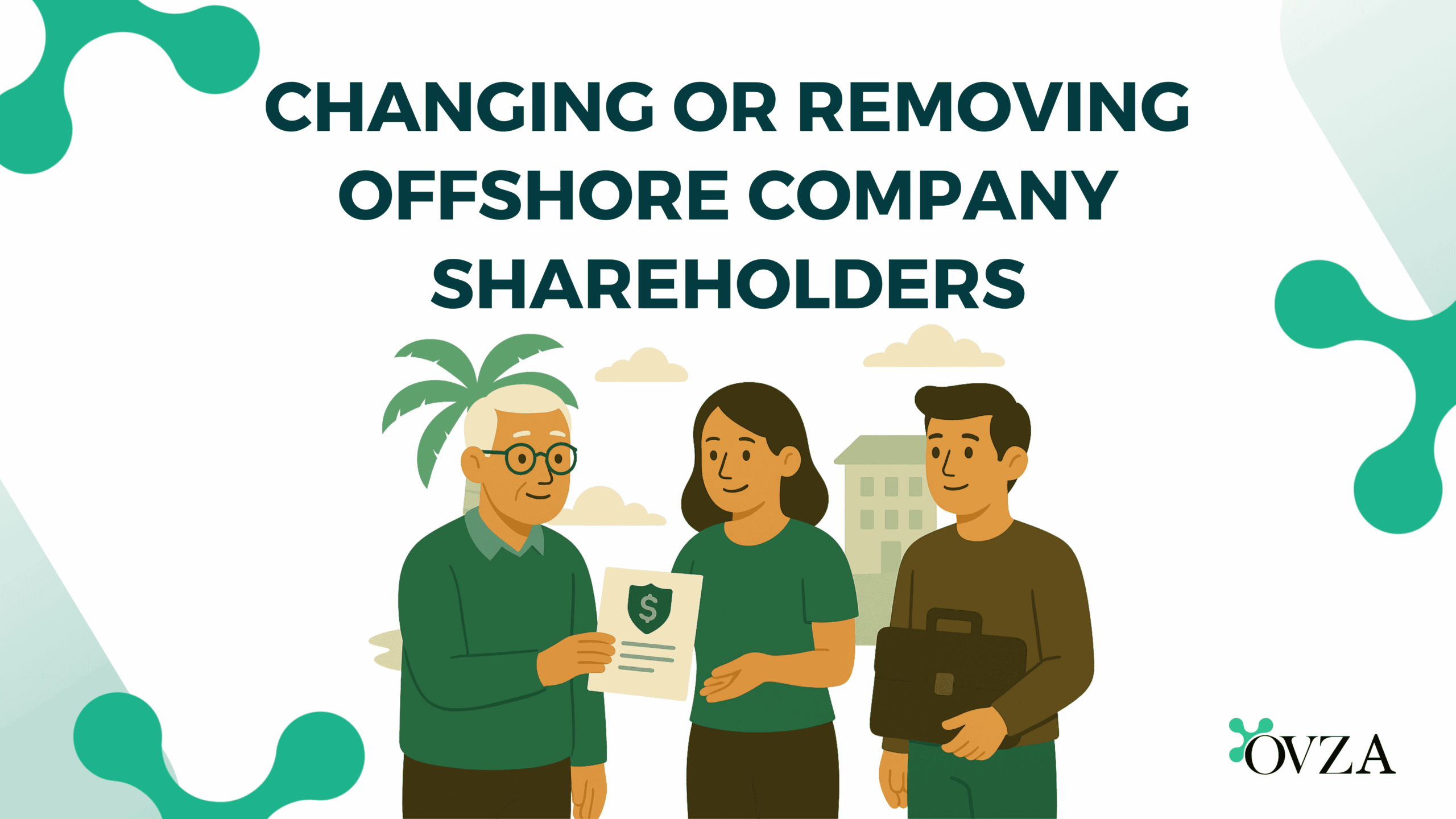
Changing or removing shareholders in offshore companies and updating ownership while ensuring compliance and governance across jurisdictions. The modification of ownership in offshore companies, including the addition, removal, or substitution of shareholders, is a critical aspect of corporate governance with direct implications for liability, control, and compliance obligations. Offshore jurisdictions such as Panama, Belize, the British Virgin Islands, and Seychelles provide legal frameworks that allow corporate flexibility while safeguarding confidentiality and asset protection. Changes in shareholder composition must comply with each jurisdiction’s corporate legislation, the company’s articles of incorporation or memorandum, and relevant international reporting obligations, including the US Foreign Account Tax Compliance Act (FATCA) and the OECD Common Reporting Standard (CRS).
The processes involved in changing or removing shareholders in offshore companies often intersect with corporate governance rules, contractual obligations among members, and regulatory reporting requirements. Jurisdictions typically permit such changes via board resolutions, shareholder agreements, or notarized transfers of shares, but the precise mechanics differ according to local legislation. For instance, Panama’s Law 32 of 1927 governs corporate structures and outlines procedures for transferring membership interests in offshore companies.
Legal Principles Governing Changes in Offshore Shareholders
The governance of offshore companies permits significant flexibility in the modification of shareholder structures, subject to the corporate legislation of the jurisdiction and the provisions in the company’s constitutional documents. Changing or removing shareholders affects both the ownership rights and voting control, and must be executed in compliance with the relevant corporate laws of the jurisdiction in which the company is registered. For example, in Panama, Law 32 of 1927 regulates the transfer and substitution of shares, establishing that shareholder modifications are legally recognized once proper documentation is filed with the Public Registry.
In offshore jurisdictions like Belize, the British Virgin Islands, and Seychelles, the transfer or removal of shareholders generally requires the execution of a share transfer instrument or a deed of assignment, often notarized and, in certain jurisdictions, filed with the Registrar of Companies. Legal principles governing these actions typically include the protection of minority shareholders, adherence to pre-emptive rights where stipulated in shareholder agreements, and the observance of contractual obligations in any internal company agreements.
International compliance also forms a critical component of shareholder changes. Offshore companies must ensure that modifications do not violate reporting requirements under FATCA and the OECD CRS. Banks and financial institutions administering offshore accounts will often require proof of any shareholder change to verify tax residency and ensure that beneficial ownership information is updated, protecting the company from exposure to penalties under global transparency regimes.
The legal principles surrounding changes in offshore shareholders balance operational flexibility, member protection, and international regulatory compliance. Offshore jurisdictions such as Panama, the British Virgin Islands, and Seychelles provide a structured framework that allows companies to adapt ownership and governance arrangements while maintaining the confidentiality and asset protection inherent to offshore structures.
Procedural Mechanisms for Changing or Removing Offshore Shareholders
The procedural mechanisms for changing or removing shareholders in offshore companies are governed by the company’s constitutional documents, relevant corporate laws, and the jurisdiction-specific requirements for documentation and registration. In practice, the process begins with a resolution by the board of directors or the consent of existing shareholders, depending on the company’s articles of incorporation and any applicable shareholder agreements. In Panama, for example, the Public Registry must receive notarized documentation reflecting the transfer, assignment, or removal of membership interests under Law 32 of 1927.
For jurisdictions such as the British Virgin Islands or Belize, the transfer of shares often requires execution of a share transfer form or deed of assignment, accompanied by updated share registers maintained at the company’s registered office. Removal of a shareholder may also necessitate surrender of share certificates and updates to the company’s register of members, with notarization or apostille where required. Legal counsel often coordinates these steps to ensure compliance with all statutory requirements, including pre-emptive rights and consent clauses outlined in shareholder agreements.
Offshore companies must also integrate international reporting requirements into procedural mechanisms. Any change in shareholders can trigger obligations under FATCA and the OECD CRS, as financial institutions will require updated information on beneficial owners to ensure proper tax compliance. Documentation proving the identity, shareholding percentage, and jurisdiction of tax residence of new or removed shareholders is often necessary to avoid exposure to penalties or account restrictions.
The procedural frameworks in offshore jurisdictions emphasize accuracy, notarization, and compliance, ensuring that changes or removals of shareholders are legally valid and enforceable. The combination of internal governance measures, statutory requirements, and international reporting obligations establishes a clear, structured pathway for modifying shareholder composition in Panama, Belize, the British Virgin Islands, and other common offshore jurisdictions.
Step-by-Step Process for Changing or Removing Offshore Company Shareholders
Step 1: Notify OVZA of the Intended Shareholder Change
The process begins by formally informing OVZA of the intention to add, remove, or substitute a shareholder in the offshore company. At this stage are communicated so that the applicable legal and compliance requirements can be assessed based on the jurisdiction.
Step 2: Submission of KYC and Due Diligence Documents
The incoming shareholder, or the remaining shareholder in the case of a removal, must submit full KYC and due diligence documentation. This typically includes proof of identity, proof of address, and any jurisdiction-specific compliance documents required under applicable AML/CFT regulations.
Step 3: KYC Review and Compliance Approval
OVZA will review the submitted documentation to ensure compliance with local corporate laws, international AML standards, and banking and regulatory requirements. Only once the KYC review is successfully completed can the shareholder change proceed. This step is essential to ensure continued compliance with FATCA, OECD CRS, and registered agent obligations.
Step 4: Execution of Required Corporate Documentation
Before any shares are transferred or cancelled, the company’s corporate documentation must be executed. Depending on the jurisdiction, this may include board resolutions, shareholder resolutions, share transfer instruments, or updated registers. Where required by law, these documents must be signed, notarized, or apostilled prior to implementation of the share change.
Step 5: Update of Shareholding and Company Records
Following execution of the approved documentation, the shareholder change is formally recorded. The company’s register of members and other statutory records are updated by the registered agent to reflect the revised ownership structure, making the change legally effective under the laws of the relevant jurisdiction.
Strategic and Compliance Considerations in Modifying Offshore Shareholders
The strategic management of shareholder changes in offshore companies requires careful consideration of corporate governance, asset protection, and international compliance obligations. Adjusting the shareholder structure can influence voting control, profit distribution, and liability allocation, making it essential to align changes with the company’s operational strategy. In jurisdictions such as Panama, Belize, and the British Virgin Islands, structuring the transfer or removal of shares through properly executed deeds and resolutions ensures both legal validity and operational continuity.
Compliance with international regulatory standards is a central aspect of strategic planning. Changes in ownership trigger verification under FATCA and the OECD CRS, requiring the disclosure of new beneficial owners to financial institutions and relevant tax authorities. Properly documenting the transfer and updating registers protects the company from non-compliance penalties and preserves the integrity of its offshore structure.
Strategically, offshore companies can use shareholder changes to optimize tax planning, protect assets, and adjust ownership for business purposes without compromising confidentiality. Mechanisms such as shareholder agreements and internal resolutions provide flexibility for dispute resolution, succession planning, and the controlled introduction or exit of members. Jurisdictions including Seychelles, the British Virgin Islands, and Panama allow these adjustments while maintaining the privacy and limited liability protections that are characteristic of offshore structures.
Careful planning, documentation, and adherence to both local corporate laws and international reporting obligations are essential for effective management of shareholder changes. By integrating legal, operational, and compliance considerations, offshore companies can ensure that modifications to shareholder composition are executed smoothly, preserve strategic objectives, and maintain regulatory conformity across jurisdictions.
Conclusion
Changing or removing shareholders in offshore companies is a legally sensitive process that requires adherence to local corporate legislation, the company’s constitutional documents, and international compliance obligations. Jurisdictions such as Panama, Belize, the British Virgin Islands, and Seychelles provide structured frameworks that allow flexibility in ownership and governance while protecting confidentiality and limiting liability. Proper execution of board resolutions, share transfer instruments, and registration with the relevant authorities ensures legal validity, while compliance with FATCA and the OECD CRS safeguards the company within global transparency standards. Strategic planning, documentation, and attention to procedural and compliance requirements enable offshore companies to manage shareholder changes effectively while preserving operational efficiency and asset protection.
Disclaimer: The information provided on this website is intended for general reference and educational purposes only. While OVZA makes every effort to ensure accuracy and timeliness, the content should not be considered legal, financial, or tax advice.