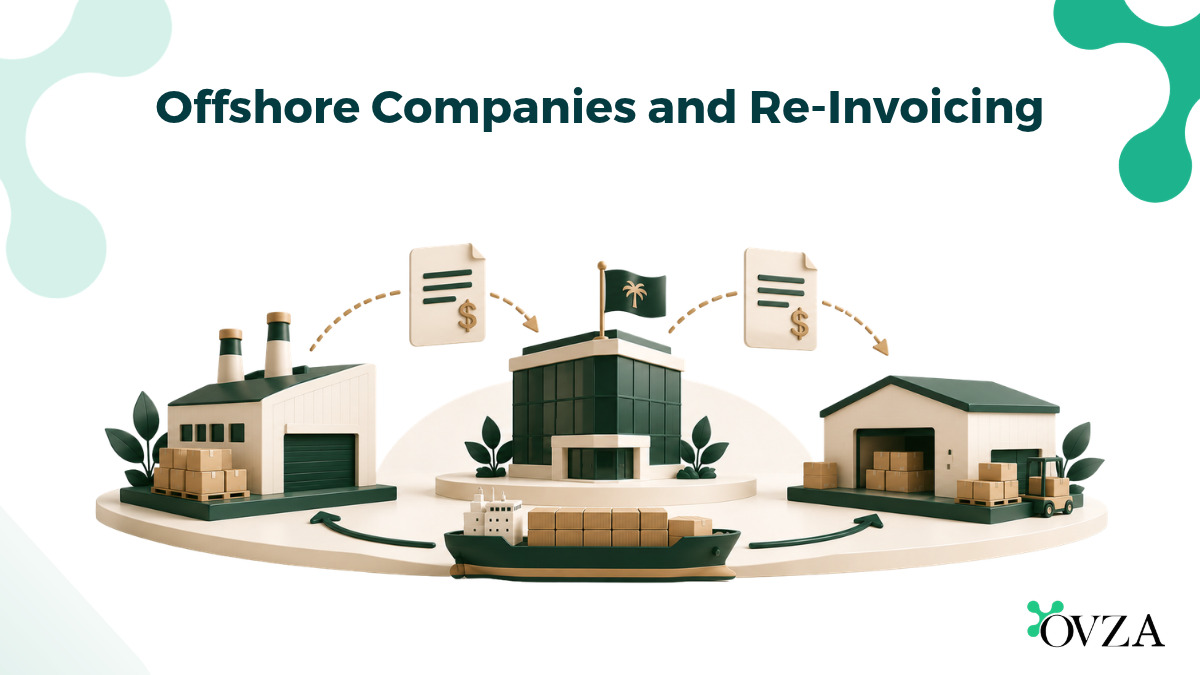
In cross-border trade law, re-invoicing refers to an operational arrangement where an intermediary corporate entity established in a tax-neutral or low-tax jurisdiction is interposed into the international commercial supply chain between an exporting manufacturer and an importing purchaser. The physical movement of merchandise proceeds directly from the manufacturer’s factory or port of origin to the customer’s destination terminal. Concurrently, the documentary title, contractual obligations, and financial settlements are routed through the intermediary offshore company. The offshore entity acquires the consignment from the producer under an initial purchase contract and resells the goods to the ultimate buyer or a regional distribution affiliate at a marked-up invoice price.
Historically, re-invoicing companies operated as administrative conduits designed primarily to accumulate untaxed commercial margins outside high-tax jurisdictions without maintaining physical operational overhead. During the late twentieth century, multinational enterprises routinely deployed corporate subsidiaries in jurisdictions such as the British Virgin Islands, Panama, or Bermuda to absorb substantial trading spreads, insulate parent companies from commercial liabilities, and accumulate foreign exchange reserves outside domestic currency controls. These structures relied heavily on the formalistic separation of corporate personality established under foundational common-law jurisprudence such as Salomon v. A. Salomon & Co. Ltd.
Modern international taxation and trade compliance frameworks have altered the legal threshold for offshore trading operations. Initiatives led by the Organisation for Economic Co-operation and Development (OECD), particularly the Base Erosion and Profit Shifting (BEPS) Actions 8–10, combined with domestic General Anti-Avoidance Rules (GAAR) and economic substance mandates, have shifted judicial and regulatory scrutiny from formal legal documentation to substantive economic reality. Tax administrations routinely apply substance-over-form doctrines to look past paper transactions and assess whether an intermediary performs real commercial functions.
In the current global trade environment, deploying an offshore company for re-invoicing requires an active, defensible commercial purpose. Legitimate re-invoicing centers operate as centralized procurement hubs, regional distributors, or central treasury operations that manage foreign exchange volatility, consolidate bulk purchasing power, coordinate multi-modal logistics, and extend trade credit. To withstand audits by revenue services and customs authorities, these entities must perform verifiable operational functions, manage genuine commercial risks, and maintain local economic substance proportional to the profits they generate.
Contractual Architecture and the Passage of Title
The legal foundation of an offshore re-invoicing transaction rests on two separate, sequential contracts for the international sale of goods, typically governed by the United Nations Convention on Contracts for the International Sale of Goods (CISG) or English commercial law under the Sale of Goods Act 1979:
- Contract One (Upstream Purchase): Governs the sale of goods between the primary manufacturer and the offshore re-invoicing company. This agreement defines factory-gate or port-of-origin delivery terms, quality specifications, and the base purchase price.
- Contract Two (Downstream Resale): Governs the subsequent resale of the identical consignment between the offshore re-invoicing company and the buyer or regional operating subsidiary. This agreement defines destination delivery obligations, credit terms, warranty coverage, and the marked-up resale price.
A defining legal characteristic of re-invoicing is the structural separation between physical cargo transit and documentary title transfer. The goods are shipped directly from the manufacturer to the ultimate consignee under a bill of lading or sea waybill that identifies the customer as the ultimate notify party. However, legal and constructive possession of the goods passes through the offshore intermediary via negotiable shipping documents. The offshore company momentarily holds legal title frequently termed “flash title” at the moment of shipment or during international transit, endorsing the bills of lading or issuing delivery orders to the final purchaser upon receiving financial settlement or letter of credit confirmation.
Under private international law and standard Incoterms 2020 (such as FOB, CIF, or DDP), the timing of risk and property transfer must be precisely synchronized between the upstream and downstream contracts. If Contract One stipulates that risk and property pass to the offshore buyer upon loading at the port of origin (FOB), but Contract Two dictates that the offshore company retains risk until destination delivery (DDP), the offshore company legally assumes open-transit marine and inventory risk.
Conversely, if the two contracts contain mirror terms with simultaneous passage of title and mutual indemnities that systematically strip the offshore company of all commercial, transit, and credit risk, onshore revenue authorities can invoke sham transaction doctrines (such as the principles established in Snook v. London and West Riding Investments Ltd.). Under these doctrines, courts can treat the offshore entity as a passive invoicing conduit, disregarding the corporate structure and reallocating all accumulated trading profits back to the onshore parent.
Transfer Pricing Compliance: FAR Analysis and the Arm’s Length Principle
When an offshore re-invoicing company transacts with associated enterprises such as purchasing goods from a parent manufacturing entity or reselling to related domestic distribution subsidiaries the pricing mechanisms fall directly under international transfer pricing legislation. Codified domestically under provisions such as Section 482 of the United States Internal Revenue Code and internationally under Article 9 of the OECD Model Tax Convention, transfer pricing statutes mandate that transactions between related parties reflect the “arm’s length principle” yielding financial results comparable to transactions conducted between independent enterprises under identical market conditions.
To evaluate whether a re-invoicing center’s commercial margin satisfies the arm’s length standard, tax authorities apply a rigorous Functional, Assets, and Risks (FAR) analysis. Profit allocation cannot be determined through arbitrary contractual markups; profits must correlate directly with the tangible activities executed, the capital deployed, and the real risks assumed by the offshore corporate personnel:
- Functions Performed: Tax authorities scrutinize whether the offshore entity’s directors and executives actively conduct supplier negotiations, supply chain planning, demand forecasting, customer credit vetting, inventory logistics, and quality assurance, or whether these functions are performed remotely by personnel employed by the onshore parent.
- Assets Employed: The analysis evaluates the physical and intangible assets utilized by the offshore entity, including enterprise resource planning (ERP) systems, specialized supply chain tracking software, trade finance facilities, working capital lines, and dedicated office infrastructure.
- Risks Assumed: The entity must demonstrate that it has the operational authority and financial capacity to manage and absorb commercial risks, including cargo loss in transit, customer non-payment, foreign currency fluctuations, product warranty claims, and market price declines while inventory is held.
Under the OECD Transfer Pricing Guidelines (specifically Actions 8–10 of the BEPS framework), transactional profits cannot be legally allocated to an entity that lacks the “control over risk” and the “financial capacity to assume risk.” If an offshore re-invoicing company lacks executive personnel possessing the commercial competence to evaluate, monitor, and mitigate operational risks, the entity cannot be compensated as a full-fledged risk-bearing distributor.
When transfer pricing audits identify non-compliance, tax administrations recalculate the intermediary’s allowable remuneration using established transfer pricing methodologies, such as the Resale Price Method (RPM) or the Transactional Net Margin Method (TNMM). Where an offshore entity is determined to perform routine administrative support rather than entrepreneurial trading, its allowable compensation is reduced to a routine cost-plus margin (typically 3% to 7% over direct operating overhead). The excess trading margin previously accumulated offshore is reallocated back to the onshore operating companies, triggering primary tax assessments, statutory interest, and administrative misreporting penalties.
Economic Substance Regulations and CFC Anti-Deferral Regimes
Operating an offshore re-invoicing center requires compliance with both local economic substance laws in the jurisdiction of incorporation and domestic anti-deferral regimes enforced by the home countries of the ultimate beneficial owners.
Economic Substance Regulations: Distribution and Service Centre Regimes
In response to European Union and OECD Forum on Harmful Tax Practices (FHTP) mandates, leading offshore jurisdictions such as the British Virgin Islands, the Cayman Islands, Bermuda, the Bahamas, and the United Arab Emirates enacted statutory Economic Substance Regulations (ESR). Under these statutes, purchasing raw materials or finished products from a foreign affiliated entity and reselling them constitutes carrying on a “Distribution and Service Centre Business,” which is classified as a regulated relevant activity.
Entities conducting distribution activities must satisfy statutory economic substance tests within the host jurisdiction. The company must demonstrate that its Core Income-Generating Activities (CIGA) are physically executed within the territory. For an offshore distribution and re-invoicing center, CIGA includes transporting and storing goods, managing inventory, taking orders, and providing consulting or other administrative services.
To maintain compliance, the entity must prove it is directed and managed locally, maintains a physical office, employs an adequate number of qualified full-time personnel within the territory, and incurs adequate operational expenditures. Failure to satisfy these tests results in progressive administrative penalties, spontaneous exchange of corporate records with foreign tax bodies, and eventual statutory dissolution.
Controlled Foreign Corporation (CFC) Anti-Deferral Frameworks
Even where an offshore company maintains full local economic substance, its trading profits remain subject to the Controlled Foreign Corporation (CFC) rules of the shareholders’ home jurisdictions. These regimes prevent domestic taxpayers from deferring income taxes through the use of foreign corporate subsidiaries.
Under the United States Internal Revenue Code, cross-border trading profits earned by a CFC frequently trigger immediate taxation under the Subpart F regime. Pursuant to IRC Section 954(d), income earned by a CFC from purchasing personal property from a related person and selling it to any person (or purchasing from any person and selling to a related person) constitutes Foreign Base Company Sales Income (FBCSI) if two conditions are met:
- The merchandise is manufactured, produced, grown, or extracted outside the CFC’s country of incorporation; and
- The merchandise is sold for use, consumption, or disposition outside that country of incorporation.
Because a typical offshore re-invoicing center purchases goods manufactured in an export hub (such as China or Vietnam) and resells them to customers located in foreign markets (such as North America or Europe), the entire trading margin falls within the statutory definition of FBCSI. This income is attributed directly to the U.S. parent or shareholders on a current pass-through basis, extinguishing foreign tax deferral regardless of whether dividends are repatriated.
Comparable anti-deferral mechanisms exist across European Union member states under the Anti-Tax Avoidance Directive (ATAD), which subjects low-taxed foreign trading profits lacking substantial commercial activity to immediate domestic attribution.
Customs Valuation Jurisprudence and the First Sale Rule
Re-invoicing centers intersect directly with international customs and tariff laws. Customs duties are assessed on an ad valorem basis against the customs value of imported merchandise at the border. Under the World Trade Organization (WTO) Valuation Agreement (Article VII of GATT 1994), the primary standard for customs valuation is the “transaction value” defined as the price actually paid or payable for the goods when sold for export to the country of importation.
In a tripartite re-invoicing arrangement, two distinct commercial sales values exist:
- Transaction One Value: The purchase price paid by the offshore re-invoicing company to the original foreign manufacturer (e.g., $100 per unit).
- Transaction Two Value: The marked-up resale price charged by the offshore re-invoicing company to the importing party (e.g., $140 per unit).
If customs authorities determine that Transaction Two represents the true transaction value for export, customs duties are assessed against the higher $140 valuation, increasing the overall tariff liability.
Conclusion
Deploying an offshore company for re-invoicing is no longer a matter of basic corporate registration and arbitrary paper markups. In an international trade environment governed by OECD transfer pricing rules, mandatory economic substance regimes, and strict customs valuation enforcement, intermediary entities must operate as genuine commercial enterprises. By establishing operational substance, actively managing supply chain risks, and maintaining rigorous transfer pricing documentation, multinational businesses can optimize cross-border logistics and treasury management while maintaining complete regulatory compliance.
Navigating the cross-border legal, tax, and trade regulations governing international procurement hubs requires experienced corporate secretarial and tax governance support. Establishing compliant corporate structures, maintaining statutory books, and executing robust intercompany agreements ensures that your enterprise maintains long-term credibility across global markets.

Add OVZA to Google Preferred Sources
Make OVZA your preferred source to ensure you can easily discover our latest insights, research, and trusted content directly through Google.

Disclaimer: The information provided on this website is intended for general reference and educational purposes only. While OVZA makes every effort to ensure accuracy and timeliness, the content should not be considered legal, financial, or tax advice.