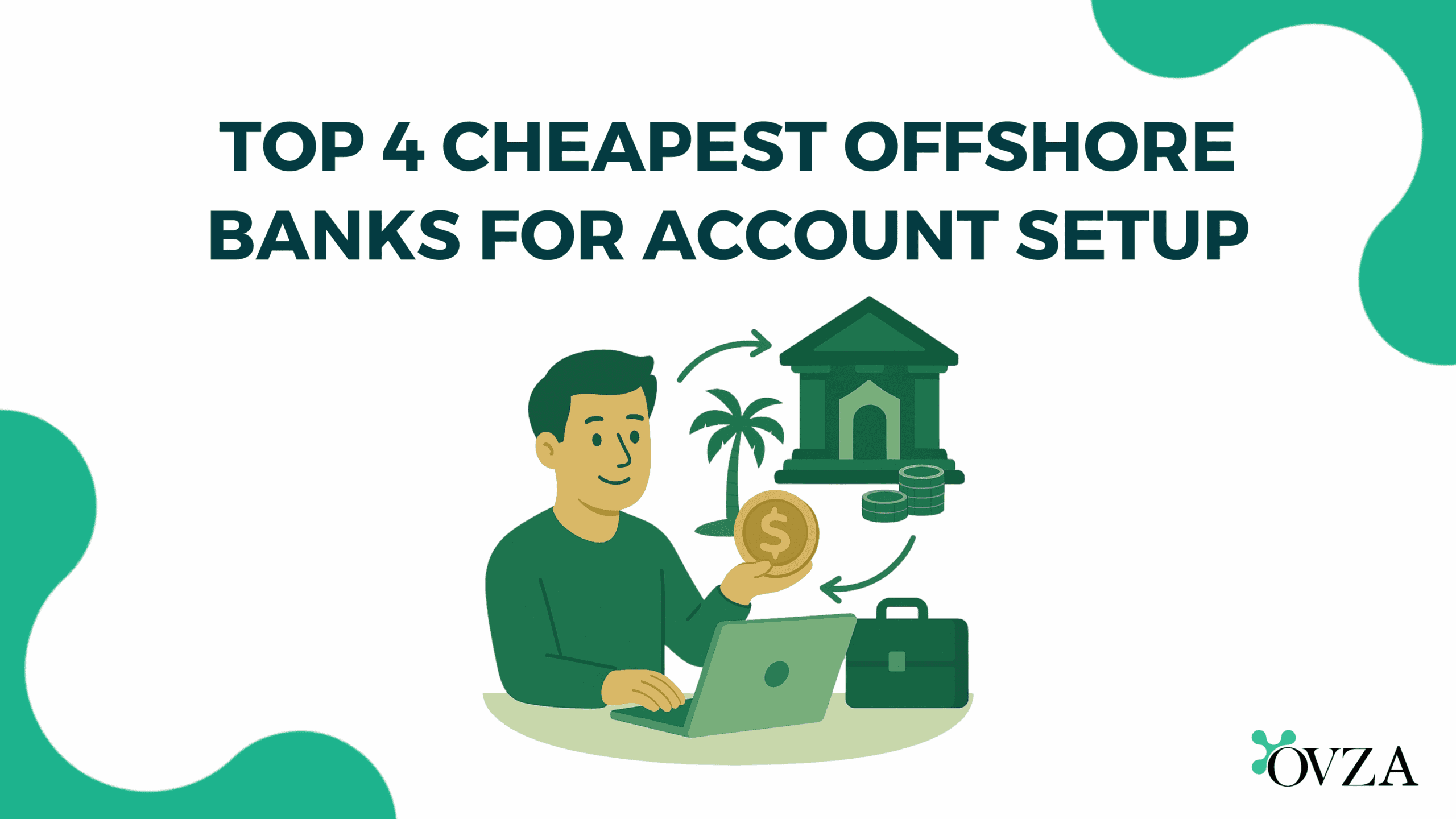
Finding the cheapest offshore bank account is not only about upfront fees; it’s about getting lawful, durable access to cross-border payments.
What follows is a practitioner-level guide to four widely used, low-cost providers, two electronic money institutions (EMIs) in the UK/EU, one payment institution with global corridors, and one Puerto Rico bank-style IFE, framed around licensing, onboarding requirements, and ongoing compliance. Throughout, we keep sight of the difference between safeguarded e-money and deposit-taking banks, CRS and FATCA reporting, and the documentation packs that make or break fast approvals.
If your mandate is to open offshore bank account facilities quickly, at minimal cost, and without compromising statutory compliance, this analysis sets out where each option fits and how to stay onside.
1. Sokin (United Kingdom)

Fees: None
Account application processing time: 1 Week
Sokin issues multi-currency business accounts under the UK Electronic Money Regulations rather than the banking regime. That means client funds are safeguarded with designated institutions, not covered by a deposit guarantee scheme.
For purposes of the cheapest offshore bank account search, Sokin’s headline is simple: zero setup fee and ultra-fast onboarding for straightforward structures, which makes it attractive for holding companies and SMEs that primarily need IBAN/SEPA/SWIFT rails and FX. Legally, onboarding is anchored in the UK Money Laundering Regulations 2017 (enhanced CDD where risk requires), with standard requirements: certified passport, proof of address, UBO chart to natural persons, description of business purpose and expected payment flows.
Because Sokin is an EMI, it cannot intermediate deposits or lending, but for a low cost offshore bank account alternative focused on payments, it is often the quickest path to utility.
2. 3S Money (United Kingdom)
Fees: USD 300
Account application processing time: 1 to 2 Months
3S Money operates as an EMI with relationship-manager-led onboarding, issuing named business IBANs across multiple currencies.
The USD 300 entry fee keeps it squarely in the cheapest offshore bank account conversation while providing more hands-on compliance support than many app-only wallets. As an e-money issuer, 3S Money safeguards client funds and focuses on payment services under PSD2/EMD; it is therefore a strong choice when you must open offshore bank account capability that will be scrutinised by counterparties, auditors, or investors.
Expect a bank-grade file: constitutional documents, cap table/UBO trace, live website or trading evidence where relevant, and source-of-funds narratives for initial funding. For regulated sectors (crypto-adjacent, MSBs, sensitive geographies), anticipate enhanced due diligence and, occasionally, risk-based refusal, an unavoidable reality after AMLD5 and FATF expectation-setting.
3. DNBC Financial Group (Canada)
Fees: Minimum Deposit of USD 1,250
Account application processing time: 4 Working Days
To be blunt, DNBC Group is OVZA’s favorite offshore EMI. DNBC positions itself between EMIs and traditional banks: multi-currency business accounts with online onboarding, but a firmer stance on operational discipline. The minimum deposit of USD 1,250 keeps DNBC competitive for a low cost offshore bank account while signalling seriousness to compliance teams.
Where clients need predictable corridors (USD/EUR/GBP/others) and faster human review than some large banks deliver, DNBC’s model, standard KYC with enhanced checks for higher-risk industries, can be a pragmatic middle ground.
The legal frame is familiar: AML/CTF controls aligned to local licensing rules, sanctions screening, ongoing transaction monitoring, and periodic KYC refresh. For holding companies, treasury SPVs, or trading entities that will run recurring cross-border payables/receivables, the “minimum deposit + scheduled review” pattern often produces smoother operations after go-live.
4. CBiBank (Puerto Rico)
Fees: Account Opening Fee of USD 3,000
Account application processing time: 5 Working Days
CBiBank is licensed in Puerto Rico as an International Financial Entity (IFE), giving it a more bank-like posture than EMIs while retaining fast remote onboarding. The commercial hallmark is a USD 3,000 application fee with no minimum deposit and no monthly fee thereafter, which can be compelling for asset-holding structures that prefer to keep working capital elsewhere.
From a legal vantage point, Puerto Rico sits within the U.S. tax and regulatory perimeter: FATCA applies; the United States is outside the OECD CRS system (banks still collect tax self-certifications and perform automatic information reporting where law requires).
Onboarding is bank-grade: notarised or certified documents, UBO disclosures, proof of address, source-of-funds/wealth statements, and credible, documented business purpose.
EMI vs. Traditional Banks
Electronic Money Institutions (EMIs) are licensed to issue e-money and provide payment services (EU: EMD/PSD2; UK: Electronic Money Regulations), while traditional banks hold full banking licenses permitting deposit-taking and lending.
The legal consequence is twofold. First, client balances at EMIs are safeguarded in segregated accounts with one or more credit institutions or invested in secure assets, but they are not deposit-insured. Bank deposits, by contrast, may fall under statutory guarantee schemes (subject to jurisdictional limits). Second, EMIs are structurally payments-centric: they specialise in account issuance, FX, and transfers, whereas banks bundle payments with credit, treasury, and custody when available.
For international operators chasing the cheapest offshore bank account–style functionality with fast activation, EMIs often outperform on reach because of how they connect to the financial system.
An EMI can contract with multiple traditional banks and payment rails simultaneously, maintaining several safeguarding and correspondent relationships across currencies and regions. That multi-bank model lets an EMI route payments through whichever partner offers the best corridor, speed, or risk appetite on a given day, and it gives clients resilient access to IBAN/SWIFT/SEPA/ACH without being tied to a single house’s risk policy.
Traditional banks, by design, clear primarily through their own correspondent network and internal ecosystem. While many banks have excellent coverage, clients are ultimately constrained by that one institution’s appetite for industries, geographies, and counterparties.
If a policy shift tightens onboarding or de-risks a corridor, you live with it, or you must open yet another bank. With an EMI, the intermediary choice is abstracted: the EMI can add, rebalance, or replace partner banks behind the scenes, preserving continuity for your business account credentials.
There are trade-offs. EMIs don’t lend against balances, and you won’t get deposit insurance; some high-risk sectors or high-value settlement needs still argue for a bank. But for most holding companies, SPVs, and SMEs that simply need fast, compliant, multi-currency payments, the EMI model’s multi-bank interoperability and rapid, documentation-led onboarding make it the more flexible way to open offshore bank account capabilities that stay usable under real-world compliance pressure.
Conclusion
A workable strategy for cross-border finance is to balance price, speed, and regulatory posture rather than chase a single provider. EMIs often deliver the cheapest offshore bank account functionality because they can plug into multiple correspondent banks, while bank-style IFEs suit structures needing classic SWIFT relationships and a banking title.
Whatever you choose to open offshore bank account access, durability comes from clean KYC, documented purpose, and ongoing AML/CTF discipline. Build the file once, maintain it rigorously, and your payment rails will remain fast, compliant, and defensible.
Disclaimer: The information provided on this website is intended for general reference and educational purposes only. While OVZA makes every effort to ensure accuracy and timeliness, the content should not be considered legal, financial, or tax advice.