Maintaining an active international corporate vehicle requires verifying its legal status and operational authority to third parties. Financial institutions, regulatory bodies, judicial courts, and commercial counterparties routinely demand official documentation proving an entity’s existence and corporate representation before executing contracts or opening accounts.
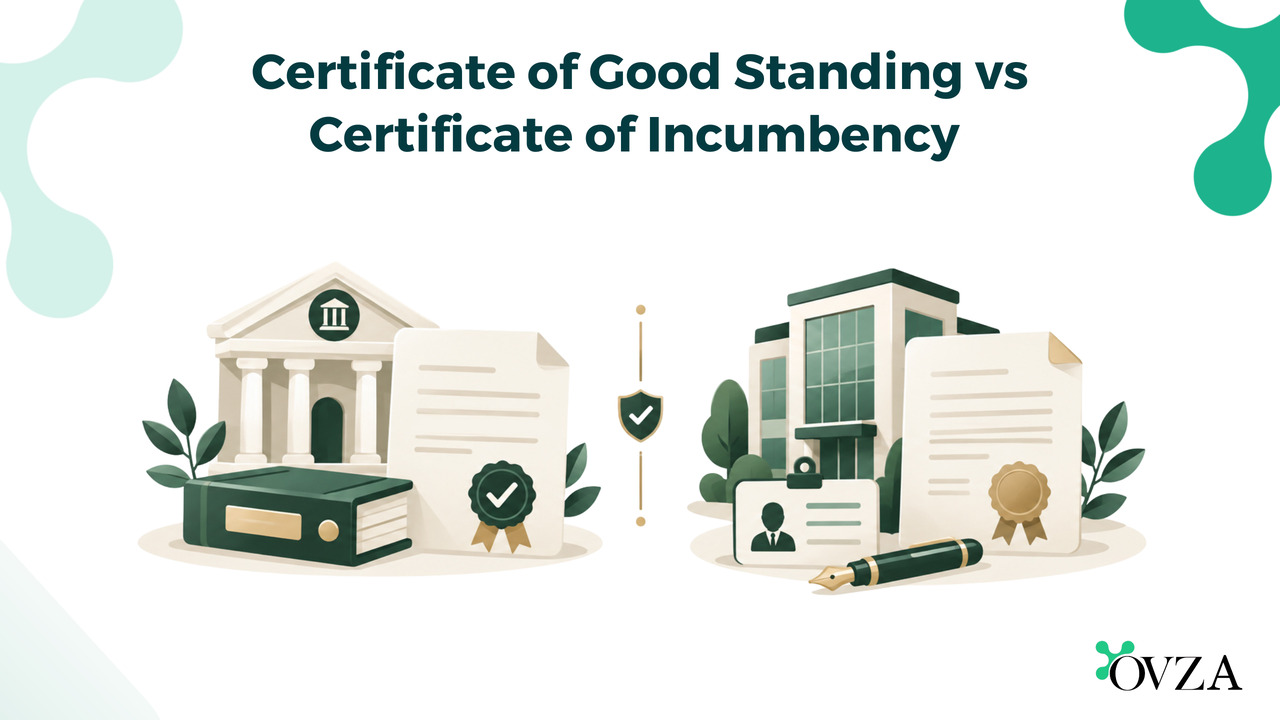
Two foundational corporate documents used in cross-border administration are the Certificate of Good Standing and the Certificate of Incumbency. While both documents serve to validate corporate standing during due diligence, they originate from different issuing authorities, contain distinct information, and fulfill fundamentally separate legal functions.
Evaluating the distinction between these two compliance instruments is essential for business owners, corporate directors, and legal advisors managing cross-border entities. Properly identifying which certificate is required prevents transactional delays, ensures smooth banking onboarding, and maintains regulatory compliance across major international financial centers.
Certificate of Good Standing
A Certificate of Good Standing, also designated as a Certificate of Existence, Certificate of Authorization, or State Confirmation, is an official public document issued directly by the corporate registry or government filing office in the entity’s jurisdiction of incorporation. The certificate serves as legal proof that the company is validly registered and maintains an active legal existence on official state records.
The primary purpose of a Certificate of Good Standing is confirming state-level statutory compliance. The document attests that the company has paid all mandatory government license fees, filed required annual returns, maintained its statutory registered agent or office, and has not entered administrative dissolution, liquidation, or strike-off procedures.
Crucially, a Certificate of Good Standing contains limited corporate structural detail. The corporate registry certifies only that the entity exists in good standing under state law; it does not list internal corporate officers, current directors, share capital distributions, or ultimate beneficial owners. The document provides external legal validation without disclosing internal governance management.
Certificate of Incumbency
A Certificate of Incumbency, frequently termed a Registered Agent Certificate, Secretarial Certificate, or Register of Officers Extract, is a private corporate document issued by the entity’s licensed Registered Agent or corporate secretary. Unlike registry-issued certificates, an incumbency certificate provides an official internal snapshot of the company’s current governance and ownership structure.
The core legal function of a Certificate of Incumbency is confirming who holds authority to bind the company. The document lists the names, addresses, and titles of active corporate directors, executive officers, and authorized signatories, while often confirming the company’s share capital, shareholder identity, registered office address, and statutory register status.
Financial institutions, escrow agents, and legal counsel rely heavily on Certificates of Incumbency during cross-border transactions. Because public corporate registries in many international jurisdictions do not publish officer lists, the licensed registered agent’s certified incumbency statement acts as authoritative proof of who holds legal signing authority to execute contracts or open corporate bank accounts.
Key Structural Differences
| Governance Vector | Certificate of Good Standing | Certificate of Incumbency |
| Primary Purpose | Confirms active legal status & statutory fee compliance | Confirms current directors, officers, & signing authority |
| Issuing Authority | Government Corporate Registry / Registrar of Companies | Licensed Registered Agent / Corporate Secretary |
| Internal Officers Listed | No. Contains no details on directors or managers | Yes. Formally lists active directors, officers, & signatories |
| Shareholders/UBOs Listed | No. Discloses zero ownership or equity details | Often Yes. May detail current shareholders & share capital |
| Public Availability | Obtainable from public registry records | Private document issued only to authorized representatives |
Governance Best Practices and Institutional Reliance
In cross-border business transactions, institutional counterparties and international banks routinely mandate receiving both documents to complete comprehensive Know Your Customer (KYC) and Anti-Money Laundering (AML) due diligence. The Certificate of Good Standing proves to the bank that the corporate entity legally exists under state law, while the Certificate of Incumbency proves who has legal authority to sign account opening documents on behalf of that entity.
Obtaining a Certificate of Incumbency requires maintaining updated statutory registers with the entity’s corporate service provider. Under international transparency guidelines enforced by the Financial Action Task Force (FATF Recommendation 24), registered agents must verify internal corporate changes before issuing incumbency certificates. Any unrecorded transfer of shares or change in directorship must be filed with the agent prior to certification.
When operating across multiple jurisdictions, both documents frequently require notarization and apostille legalization under the Hague Apostille Convention. Foreign courts, land registries, and institutional banks require verified apostilled certificates to confirm foreign entity status and corporate execution authority during international real estate acquisitions, cross-border mergers, or judicial litigation.
Conclusion
Evaluating the legal distinctions between a Certificate of Good Standing and a Certificate of Incumbency ensures efficient cross-border corporate administration. A Certificate of Good Standing provides government-certified proof that an entity maintains active legal existence, while a Certificate of Incumbency certifies the specific natural persons who hold internal board authority and signing powers.
Utilizing both instruments correctly maintains operational continuity and satisfies institutional compliance expectations. For international entities, ensuring that statutory registers and state filings remain fully updated guarantees that both certificates can be issued promptly during commercial transactions.

Add OVZA to Google Preferred Sources
Make OVZA your preferred source to ensure you can easily discover our latest insights, research, and trusted content directly through Google.

Disclaimer: The information provided on this website is intended for general reference and educational purposes only. While OVZA makes every effort to ensure accuracy and timeliness, the content should not be considered legal, financial, or tax advice.