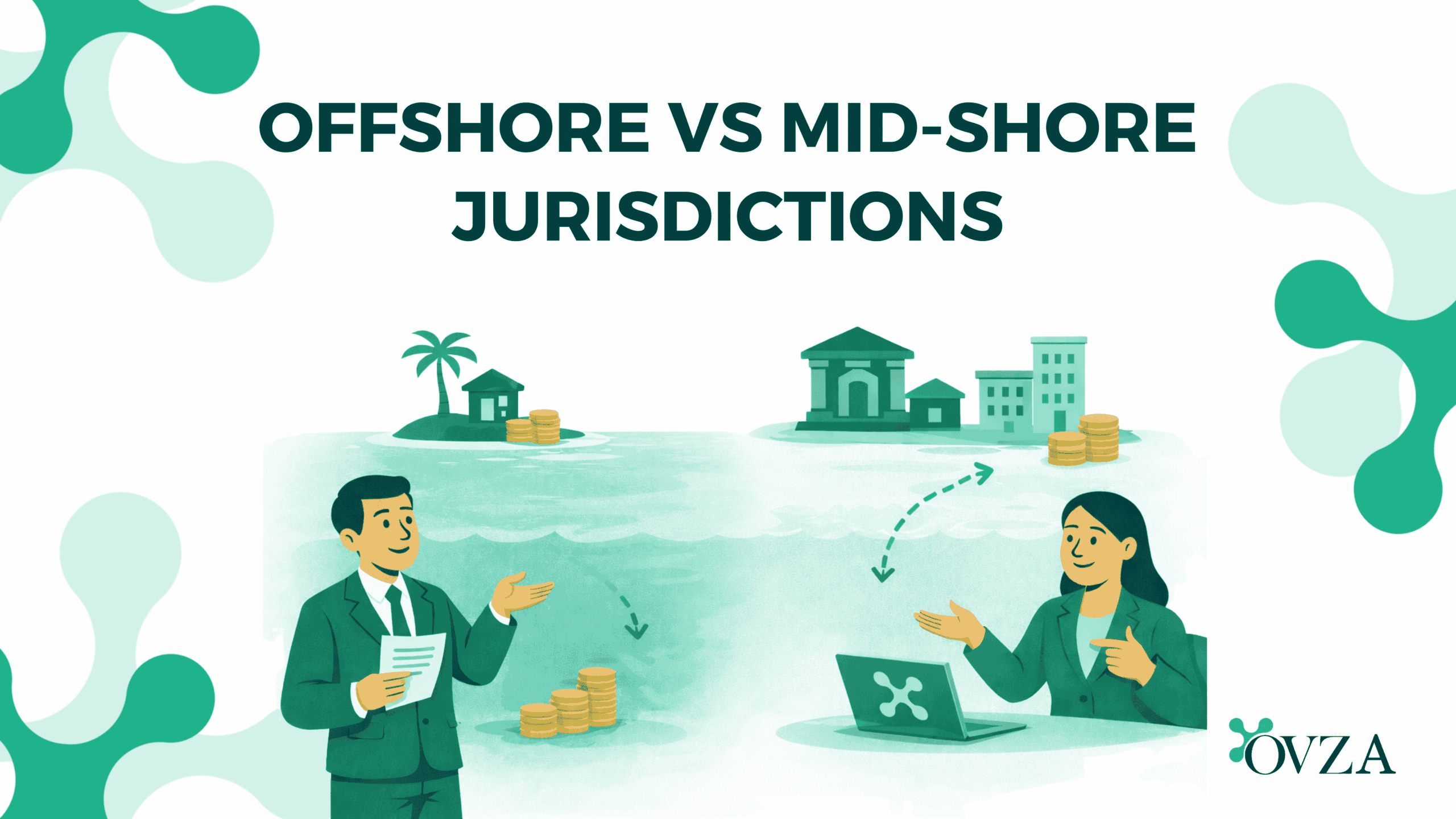
The difference between offshore and mid-shore jurisdictions is significant, and offshore is usually the better choice for most international businesses.
Many jurisdictions are marketed as “offshore-friendly” or “low-tax,” but in legal terms they operate under very different frameworks. Understanding this distinction is essential before registering an offshore company, opening a bank account, or building a long-term international structure.
At its core, the difference between offshore and mid-shore jurisdictions is not about tax rates alone, but about whether a company is legally separated from the domestic corporate and tax regime of the country in which it is incorporated. This legal separation is what determines how a company is regulated, taxed, reported, and perceived by banks and authorities.
This article explains what offshore jurisdictions and mid-shore jurisdictions actually are, how they differ in law, and why offshore jurisdictions are usually the better choice for most international business owners.
What Is an Offshore Jurisdiction?
An offshore jurisdiction is a country or territory that has enacted specific legislation for international or non-resident companies. These laws are designed to host companies that do not conduct business within the local economy and instead operate internationally. As a result, offshore companies are typically exempt from local corporate income tax and excluded from the standard domestic corporate regime.
The defining feature of an offshore jurisdiction is not secrecy or low taxation, but statutory intent. Offshore laws are written expressly to create a legal category of companies that are treated differently from domestic entities. This includes restrictions on local trading, exemptions from local taxes on foreign-source income, and simplified compliance obligations compared to resident companies.
In other words, offshore jurisdictions do not merely offer incentives to companies; they legally classify offshore companies as a different type of entity altogether.
Below is a list of offshore jurisdictions:
| Region | Jurisdiction | Registration Fee (USD) | Annual Renewal Fee (USD) |
| Africa | Seychelles | 595 | 590 |
| The Americas | Anguilla | 1,040 | 1,030 |
| The Americas | Antigua and Barbuda | 1,600 | 1,350 |
| The Americas | Bahamas | 1,360 | 1,120 |
| The Americas | Belize | 990 | 1,190 |
| The Americas | British Virgin Islands | 1,690 | 1,450 |
| The Americas | Cayman Islands | 2,900 | 2,610 |
| The Americas | St. Kitts and Nevis | 1,470 | 1,390 |
| The Americas | St. Lucia | 1,850 | 1,600 |
| The Americas | St. Vincent and the Grenadines | 1,110 | 970 |
| The Americas | Panama | 1,490 | 980 |
| The Americas | Costa Rica | 1,790 | 1,350 |
| Asia Pacific | Marshall Islands | 1,090 | 890 |
| Asia Pacific | Samoa | 840 | 755 |
| Asia Pacific | Vanuatu | 1,400 | 900 |
| Asia Pacific | Cook Islands | 1,790 | 1,490 |
What Is a Mid-Shore Jurisdiction?
A mid-shore jurisdiction occupies a legal space between traditional onshore countries and true offshore jurisdictions. While these jurisdictions often promote themselves as international business hubs, companies incorporated there usually remain within the domestic corporate legal system.
Mid-shore jurisdictions may offer low corporate tax rates, territorial tax systems, or special incentives for foreign-owned companies. However, these benefits are granted inside the domestic framework, rather than through exclusion from it. The company is still considered a resident legal entity and remains subject to local corporate law, accounting standards, regulatory supervision, and often substance requirements.
As a result, a mid-shore company is not legally offshore, even if it pays little or no tax in practice.
Below is a list of mid-shore jurisdictions:
| Region | Mid-Shore Jurisdiction |
| Europe | Ireland |
| Europe | Malta |
| Europe | Cyprus |
| Europe | Estonia |
| Europe | Netherlands |
| Europe | Luxembourg |
| Asia | Singapore |
| Asia | Hong Kong |
| Middle East | United Arab Emirates |
| Middle East | Qatar |
| Asia | Malaysia (Labuan) |
| Asia | Thailand |
| Americas | United States (certain state-level structures) |
| Americas | Canada |
| Americas | Chile |
Key Differences Between Offshore and Mid-Shore Jurisdictions
In simple terms, the difference between offshore and mid-shore jurisdictions lies in legislative intent and legal structure. Offshore jurisdictions are purpose-built to host international companies under specialized laws that remove them from the domestic corporate and tax regime.
Mid-shore jurisdictions, by contrast, operate within their domestic legal systems and offer incentives to attract foreign business, without structurally separating those companies from local law.
Below is a comparison between offshore and mid-shore jurisdictions:
| Aspect | Offshore Jurisdictions | Mid-Shore Jurisdictions |
| Legislative intent | Designed specifically for offshore and international business | Designed for domestic economy with foreign investment incentives |
| Governing framework | Dedicated offshore or international business legislation | Standard domestic corporate law |
| Legal status of companies | Statutorily separated from domestic corporate regime | Remain within domestic legal system |
| Tax treatment | Exempt from local tax on foreign-source income | Tax benefits granted through incentives or special regimes |
| Stability of regime | Structural and long-term by design | Subject to policy and regulatory change |
| Local trading | Typically restricted or prohibited | Generally permitted |
| Compliance scope | Tailored for international use | Full domestic compliance requirements |
| Regulatory exposure | Limited domestic oversight | Expanding domestic and international oversight |
| Long-term suitability | Built for long-term offshore structures | Often transitional or situational |
Offshore jurisdictions provide greater legal certainty, long-term stability, and predictability for international businesses, while mid-shore jurisdictions remain subject to policy changes, regulatory expansion, and shifting political priorities.
When a Mid-Shore Jurisdiction May Be the Better Choice
Although offshore jurisdictions are usually the more appropriate option for most international structures, there are situations in which a mid-shore jurisdiction can be a rational and deliberate choice. The key factor is not tax efficiency alone, but the operational and regulatory objectives of the business.
Mid-shore jurisdictions can make sense where a company requires a visible onshore presence, access to local or regional markets, or close integration with established financial systems. Businesses that rely on local licensing, regulated activities, or direct interaction with customers in a specific region may benefit from being incorporated within a domestic legal framework, even if that framework offers preferential tax treatment.
However, these benefits come with trade-offs. Mid-shore companies remain exposed to domestic legal changes, expanding substance requirements, and evolving regulatory obligations. For this reason, mid-shore jurisdictions are often better suited to operating companies with genuine regional ties, rather than pure international holding structures, asset protection vehicles, or long-term offshore arrangements.
Why the Legal Framework Matters
One of the most common mistakes in international structuring is choosing a jurisdiction based solely on advertised tax rates. While tax efficiency is often an important consideration, tax rates alone do not determine whether a company is truly offshore. The decisive factor is the legal framework under which the company is incorporated and how that framework positions the company in relation to the domestic corporate and regulatory system.
Offshore jurisdictions are countries and territories that deliberately specialise in the offshore space. Their corporate laws are drafted with the explicit intention of attracting international businesses that do not operate within the local economy. These jurisdictions want offshore companies, and their legislation reflects this intent by creating a separate legal regime for international or non-resident entities. This is why offshore jurisdictions typically enact dedicated offshore or international business companies legislation that removes qualifying companies from ordinary domestic corporate law.
In contrast, mid-shore jurisdictions are usually established financial centres or regional economic hubs. Their primary objective is not to host offshore companies, but to strengthen their position as international financial or commercial centres. To achieve this, they may offer incentives, preferential tax regimes, or special programs to attract foreign investment and multinational businesses. While such incentives can be attractive in the short term, they exist within the domestic legal system, not outside it.
This distinction is fundamental. In mid-shore jurisdictions, advantages offered to internationally focused companies are usually policy-driven rather than structurally embedded in corporate law. As a result, these benefits can be revised, restricted, or withdrawn as political priorities change or as international regulatory pressure increases.
Because offshore activity is not the central legislative objective of mid-shore jurisdictions, their corporate frameworks are not designed to provide the same level of long-term certainty, stability, or predictability that purpose-built offshore regimes offer.
Offshore jurisdictions take the opposite approach. In jurisdictions such as those traditionally associated with offshore company formation, including many Caribbean territories, international business legislation is foundational rather than incidental. Offshore laws are enacted precisely to provide long-term stability, legal certainty, and predictability for foreign-owned companies. These laws are not temporary incentives; they are structural pillars of the jurisdiction’s legal system.
For international entrepreneurs, asset holders, and digital businesses, this means that the choice between offshore and mid-shore jurisdictions is not simply a question of how much tax is paid today. It is a question of legal stability, regulatory predictability, banking treatment, privacy, and long-term resilience.
In most cases, jurisdictions that are purpose-built for offshore activity provide a more reliable foundation for international structures than jurisdictions that offer incentives without structural separation from domestic law.
Conclusion
The difference between offshore and mid-shore jurisdictions is not merely one of tax incentives, but of legal design and legislative intent. Offshore jurisdictions are built to support international companies through stable, purpose-made legal frameworks, while mid-shore jurisdictions rely on domestic systems that can change over time. For most international businesses and individuals, jurisdictions that are specifically designed for offshore activity provide greater certainty, clarity, and long-term reliability.
Disclaimer: The information provided on this website is intended for general reference and educational purposes only. While OVZA makes every effort to ensure accuracy and timeliness, the content should not be considered legal, financial, or tax advice.