When establishing an international company, business owners often assume that the company must maintain its corporate bank account in the same jurisdiction where it is incorporated. In practice, these two locations can be separate.
An international company may be incorporated in one jurisdiction while maintaining its banking relationship with a financial institution in another country. This can be particularly relevant for offshore structures, where local banking options may be limited or where traditional domestic banks may have limited appetite for non-resident corporate clients.
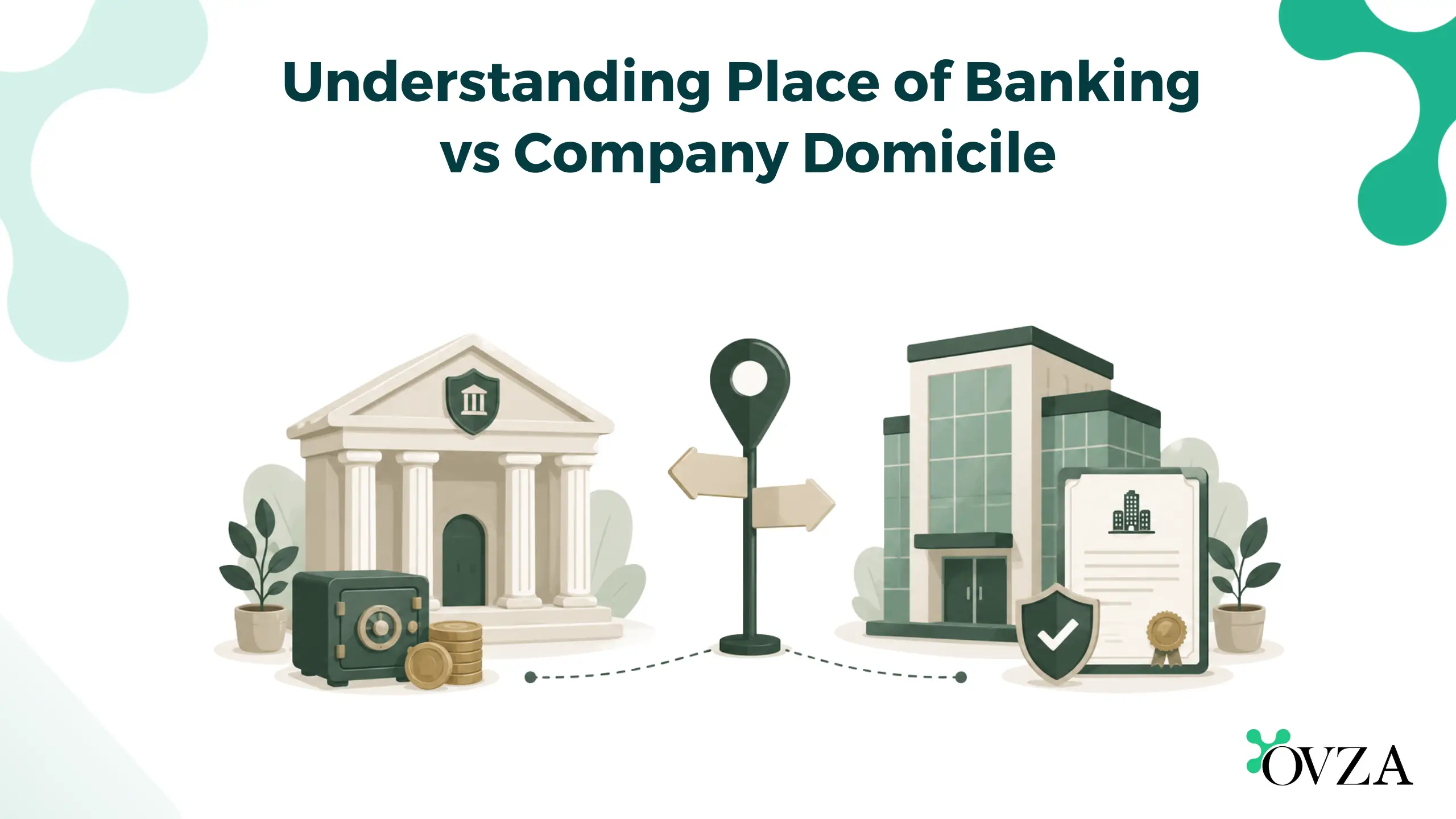
Understanding the difference between place of banking vs company domicile allows business owners to build a corporate structure around their actual commercial requirements, including international payments, multi-currency transactions, and access to suitable financial infrastructure.
Under modern international entity banking compliance 2026 standards, selecting an appropriate banking location involves more than simply choosing a country with a reputable financial sector. The company’s activities, ownership, source of funds, expected transactions, and commercial connection to the banking jurisdiction all form part of the onboarding process.
- Company Domicile and Place of Banking Explained
- Why Offshore Companies May Use International Banking?
- Offshore Domicile Does Not Automatically Mean Offshore Banking
- The International Three-Location Model
- Comparing Different Banking Arrangements
- Strategic Advantages of Separating Banking from Domicile
- Non-Resident Corporate Banking and Compliance
- Banking Location Does Not Automatically Determine Tax Residence
- Step-by-Step International Banking Setup
- Conclusion
Company Domicile and Place of Banking Explained
What Is Company Domicile?
Company domicile refers to the jurisdiction in which a company is legally incorporated and registered.
This is the jurisdiction whose corporate legislation governs the entity and where its statutory corporate framework is maintained. Incorporation documents, registered office requirements, corporate registers, and governance obligations are generally connected to the company’s domicile.
The company domicile therefore establishes the legal framework under which the entity operates.
What Is the Place of Banking?
The place of banking refers to the jurisdiction in which the company’s bank or financial institution is located.
A company does not necessarily need to maintain its corporate account in the same jurisdiction where it was incorporated. International businesses may establish banking relationships elsewhere when they require access to specific currencies, payment networks, financial services, or international markets.
For non-resident companies, however, banking relationships can involve enhanced due diligence. Financial institutions may request a clear explanation of why the company requires an account in another jurisdiction and may review its customers, suppliers, business activities, expected transaction volumes, and beneficial ownership.
Why Offshore Companies May Use International Banking?
Offshore companies frequently operate internationally rather than within the jurisdiction where they are incorporated. As a result, the banking infrastructure available in their incorporation jurisdiction may not always match their commercial requirements.
Traditional domestic banks can also have different policies toward non-resident companies. A bank may require a meaningful local connection, such as local operations, customers, employees, or business activity, before accepting a corporate account application.
For this reason, offshore companies may consider international banks, offshore banks, or regulated Electronic Money Institutions (EMIs) that are accustomed to working with international and non-resident businesses.
These financial institutions may provide services such as multi-currency accounts, international wire transfers, corporate payment solutions, and access to major international payment networks.
This does not mean that an offshore company is legally required to use an offshore bank. An offshore company may be able to maintain an account with a traditional bank, provided that the bank accepts the structure and the company satisfies its KYC, AML, and onboarding requirements.
The key consideration is whether the banking relationship is appropriate for the company’s business model.
Offshore Domicile Does Not Automatically Mean Offshore Banking
It is important to distinguish between offshore incorporation and offshore banking.
A company can be incorporated in an offshore jurisdiction and maintain its banking relationship elsewhere. Conversely, depending on the circumstances, an international company may maintain a banking relationship within its incorporation jurisdiction.
The decision should be based on the company’s operational requirements rather than assuming that incorporation and banking must occur in the same location.
For example, an international trading company could be incorporated in an offshore jurisdiction while maintaining a corporate account with a financial institution in an established international banking center. The company may use that account to receive customer payments, pay international suppliers, and manage different currencies.
The banking relationship should have a legitimate commercial rationale and remain consistent with the financial institution’s compliance requirements.
The International Three-Location Model
For some international businesses, three different locations form part of the overall corporate structure:
Founder Residence: The country where the company’s shareholders, directors, or beneficial owners reside.
Company Domicile: The jurisdiction where the company is legally incorporated and registered.
Banking Location: The jurisdiction where the company’s bank or financial institution maintains its corporate account.
These locations do not necessarily need to be identical.
This separation can allow an international business to select its corporate domicile based on its preferred legal and governance framework while selecting its banking location according to its payment, currency, and financial-service requirements.
Comparing Different Banking Arrangements
| Banking Arrangement | Typical Purpose | Potential Benefits | Key Consideration |
| Traditional Domestic Bank | Companies with a strong local connection | Familiar local banking infrastructure | May have limited appetite for non-resident offshore companies |
| Bank in Company Domicile | Companies seeking banking close to incorporation | Direct connection between company and financial institution | Local banking options may be limited |
| International / Third-Jurisdiction Bank | Businesses with international operations | Multi-currency services and international payment infrastructure | Enhanced KYC/AML requirements may apply |
| International EMI / Payment Institution | Companies requiring cross-border payment services | Multi-currency accounts and international payment capabilities | EMIs are not banks and their services differ from traditional banking |
Strategic Advantages of Separating Banking from Domicile
1. Access to Suitable Financial Infrastructure
The jurisdiction selected for incorporation does not necessarily offer the financial infrastructure required by an international business.
An offshore jurisdiction may provide an appropriate corporate framework while a separate international banking center may offer more suitable payment infrastructure, currencies, or financial services.
Separating the two allows the business owner to evaluate each component independently.
2. Multi-Currency Banking
Companies working with international customers and suppliers may require accounts supporting several major currencies.
A suitable international banking or EMI relationship can provide access to currencies such as USD, EUR, and GBP, depending on the provider. This can make international collections and supplier payments more straightforward.
The availability of specific currencies and payment rails will depend on the individual financial institution and account arrangement.
3. International Payment Infrastructure
For businesses receiving revenue from customers across multiple markets, access to appropriate international payment networks can be an important part of corporate treasury management.
A banking relationship in an established financial center may provide payment services that are more closely aligned with the company’s international transaction requirements.
4. A Banking Structure Based on Business Needs
Rather than choosing a bank solely because it is located in the same country as the company, businesses can evaluate financial institutions based on their actual requirements.
Factors can include supported currencies, transaction limits, payment methods, account fees, minimum balances, online banking capabilities, compliance requirements, and experience with non-resident companies.
Non-Resident Corporate Banking and Compliance
International banking does not mean anonymous banking.
Banks and financial institutions must generally understand who owns and controls the company, what the company does, where its revenue originates, and how the account will be used.
A non-resident corporate banking application may therefore require:
- Certificate of Incorporation
- Memorandum and Articles of Association
- Register of Directors and Members
- Beneficial ownership information
- Identification and address verification for directors and UBOs
- Business plan or company profile
- Client contracts and invoices
- Information regarding customers and suppliers
- Expected transaction volumes and currencies
- Source of funds and, where applicable, source of wealth information
Requirements vary between financial institutions and depend on the company’s activities and risk profile.
Banking Location Does Not Automatically Determine Tax Residence
Another important distinction is that the location of a corporate bank account does not, by itself, determine where a company is tax resident. Tax residence can depend on factors including applicable domestic legislation, management and control, place of effective management, local activities, and relevant tax treaties.
Likewise, incorporating a company offshore does not automatically eliminate tax obligations that may arise in the jurisdictions where the company, its owners, employees, or business activities are located.
Corporate banking should therefore be considered as one part of a broader international business structure rather than as an independent tax solution.
Step-by-Step International Banking Setup
Establishing a non-resident corporate bank account can generally be approached through four stages.
Step 1: Assess the Business Model
Identify the company’s activities, customer locations, currencies, expected transaction volumes, and payment requirements.
Step 2: Select the Banking Institution
Compare suitable banks or regulated financial institutions based on their services, eligibility requirements, supported currencies, and experience with international companies.
Step 3: Prepare the Corporate and Commercial Documents
Prepare the company’s incorporation documents, ownership information, identification documents, business plan, contracts, invoices, and other evidence requested during KYC and AML review.
Step 4: Complete Compliance and Account Onboarding
Submit the application, respond to compliance questions, complete verification procedures, and provide any additional information required before the account becomes operational.
Conclusion
Understanding company domicile vs place of banking helps international business owners recognize that incorporation and banking are two separate elements of corporate structuring.
An offshore company does not necessarily have to use a bank in the same jurisdiction where it is incorporated. In some cases, an international or offshore banking relationship may be more suitable, particularly where local banking options are limited or traditional banks have a restricted appetite for non-resident companies.
The objective is not simply to separate the two locations, but to select a corporate domicile and banking relationship that each serve a clear commercial purpose.
With the right structure, international businesses can establish appropriate corporate banking arrangements, access relevant currencies and payment infrastructure, and build a practical foundation for cross-border operations.

Add OVZA to Google Preferred Sources
Make OVZA your preferred source to ensure you can easily discover our latest insights, research, and trusted content directly through Google.

Disclaimer: The information provided on this website is intended for general reference and educational purposes only. While OVZA makes every effort to ensure accuracy and timeliness, the content should not be considered legal, financial, or tax advice.