When establishing an international company, entrepreneurs often encounter several forms of corporate capital that can initially appear confusing. Authorized capital, issued capital, and paid-up capital all relate to a company’s shares, but each describes a different aspect of the company’s ownership and funding structure. Understanding these distinctions is an important part of choosing the appropriate corporate structure and preparing the company’s constitutional documents.
So, what does capital mean in offshore company formation? In simple terms, corporate capital generally refers to the shares a company is authorized to issue, the shares actually allocated to its shareholders, and the amount paid for those shares. Unlike some jurisdictions where substantial minimum capital requirements may apply, many international company jurisdictions provide greater flexibility in determining how share capital is structured.
The exact requirements vary depending on the jurisdiction and company type. Some jurisdictions may have minimum capital requirements, while others allow companies to incorporate with very low or no prescribed minimum paid-up capital. For this reason, founders should examine the specific corporate legislation and fee structure applicable to the jurisdiction they select.
- Understanding the Three Types of Share Capital
- Authorized Capital
- Issued or Allotted Capital
- Paid-Up Capital
- Why Capital Structure Matters in Offshore Company Formation?
- Authorized Capital vs. Paid-Up Capital
- Minimum Share Capital Requirements
- Share Classes and Capital Flexibility
- Capital and Corporate Banking
- Capital Changes After Incorporation
- Compliance and Record-Keeping
- Заключение
Understanding the Three Types of Share Capital
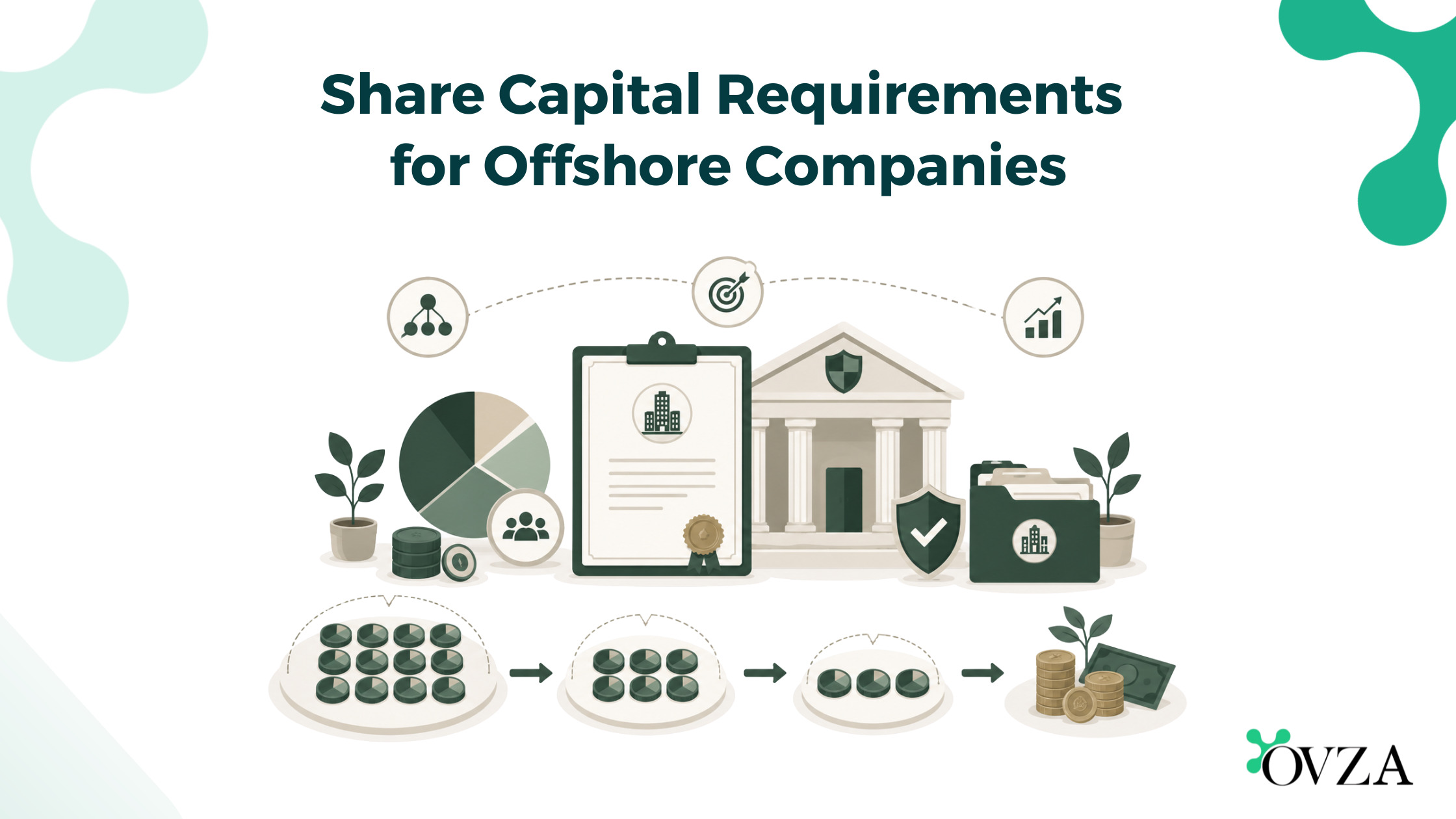
To understand what capital means in offshore company formation, it is useful to separate the three concepts that commonly appear in corporate documentation: authorized capital, issued capital, and paid-up capital. Although these terms are related, they do not represent the same amount of money.
The distinction becomes particularly important when determining ownership percentages, bringing in future investors, structuring different share classes, or reviewing the company’s incorporation documents. A company may be authorized to issue a large number of shares while initially issuing only a small portion of those shares to its founders.
| Type of Capital | Meaning | Example |
| Authorized Capital | The maximum amount or number of shares the company is permitted to issue under its constitutional documents, where the jurisdiction uses this concept. | 50,000 authorized shares |
| Issued Capital | The shares that have actually been allotted or issued to shareholders. | 1,000 shares issued to the founder |
| Paid-Up Capital | The amount shareholders have actually paid for the shares issued to them. | $1,000 paid for 1,000 $1 shares |
These figures can be different from one another. For example, a company could have 50,000 authorized shares but issue only 1,000 shares at incorporation. If those 1,000 shares are fully paid at $1 each, the company’s paid-up capital would be $1,000 rather than the full $50,000 represented by its authorized share capital.
Authorized Capital
Authorized capital, sometimes referred to as registered or nominal capital depending on the jurisdiction, generally represents the maximum amount of share capital a company is permitted to issue under its constitutional documents. It establishes the company’s available share capacity and can provide room for future ownership changes or investment.
For example, a company may be authorized to issue 50,000 shares with a nominal value of $1 each while initially issuing only 1,000 shares to its founder. The remaining shares are not automatically owned by the company or its shareholders; they simply remain available for potential future issuance in accordance with the applicable corporate rules.
It is important to note that authorized capital does not necessarily represent money that must be deposited into a corporate bank account. Where a jurisdiction uses an authorized-capital system, the amount primarily relates to the company’s legal share structure rather than an automatic requirement to maintain the same amount of cash.
Issued or Allotted Capital
Issued capital refers to the shares that have actually been allocated to shareholders. This is the figure that normally determines the ownership percentages of the company’s members.
For example, an international company could have 50,000 shares available for issue but initially allot 1,000 shares to its founder. If that founder holds all 1,000 issued shares, they would own 100% of the issued equity even though the company has additional shares available for future issuance.
This flexibility can become useful when a company later introduces an investor, business partner, or strategic shareholder. Instead of restructuring the entire company, additional shares may be issued where permitted, allowing ownership to be adjusted according to the relevant investment or commercial arrangement.
Paid-Up Capital
Paid-up capital refers to the amount that shareholders have actually paid in relation to the shares issued to them. The amount can depend on the nominal value of the shares, the issue price, and the corporate laws governing the company.
For example, if a company issues 1,000 shares at $1 per share and the shareholder pays the full amount, the paid-up capital would be $1,000. If the jurisdiction and corporate documents permit shares to be issued on different terms, the amount paid may differ from the nominal or authorized share capital.
The distinction is important because having a particular amount of authorized or issued capital does not automatically mean that the same amount has been deposited into the company’s bank account. The company’s actual funding position should instead be assessed through its paid-up capital, shareholder contributions, loans, and other sources of corporate financing.
Why Capital Structure Matters in Offshore Company Formation?
Understanding what capital means in offshore company formation is more than a technical exercise. The company’s share structure establishes the legal foundation for ownership and can influence how future shareholders, investors, or partners are introduced.
Founders may initially issue a relatively small number of shares while retaining additional authorized or available shares for future corporate requirements, where permitted. This can provide flexibility when the business expands, introduces a new investor, establishes different classes of shares, or reorganizes its ownership.
The structure can also influence administrative costs in some jurisdictions. Certain company registries calculate annual government fees according to factors such as authorized share capital, number of shares, or the company’s specific corporate classification. As a result, selecting an appropriate capital structure at incorporation can help avoid unnecessary administrative costs while preserving sufficient flexibility for future growth.
Authorized Capital vs. Paid-Up Capital
The difference between authorized capital and paid-up capital is particularly important for new business owners. Authorized capital, where applicable, represents the company’s permitted share capacity, while paid-up capital relates to the amount actually paid for shares that have been issued.
| Capital Category | What It Represents | Must It Be Deposited Into a Bank Account? |
| Authorized Capital | Maximum share capital the company may issue under its constitutional framework | Обычно нет |
| Issued Capital | Shares actually allocated to shareholders | Not necessarily |
| Paid-Up Capital | Amount actually paid for issued shares | Represents shareholder payment, but the exact funding mechanics depend on the jurisdiction |
This distinction means that a company can have a relatively high authorized share capital while maintaining a much lower initial paid-up capital. The precise rules, however, depend on the jurisdiction, company type, share terms, and constitutional documents.
Minimum Share Capital Requirements
One of the most common questions surrounding offshore company formation is whether founders need to deposit a substantial amount of money before a company can be incorporated. The answer depends entirely on the jurisdiction and the specific type of entity being established.
Some jurisdictions permit companies to incorporate without a prescribed minimum paid-up capital, while others impose specific requirements depending on the nature of the business. Regulated businesses, financial institutions, insurance companies, investment businesses, and other licensed activities may be subject to substantially different capital requirements from ordinary commercial companies.
This is why the phrase “minimum share capital offshore” should not be treated as a universal figure. Before incorporating, founders should review the specific legislation, corporate registry requirements, licensing rules, and banking expectations applicable to their proposed business activity.
Share Classes and Capital Flexibility
Corporate capital can also be structured through different classes of shares where permitted by local law. Depending on the jurisdiction and constitutional documents, companies may be able to issue ordinary shares, preference shares, voting or non-voting shares, redeemable shares, or other classes with specific rights.
This flexibility can be useful when a company has multiple investors or expects to introduce additional shareholders in the future. Different share classes may allow the company to distinguish between voting rights, dividend entitlements, conversion rights, or other economic and governance interests.
However, share classes should not be created simply for complexity. Each class should have a clear commercial purpose, and the rights attached to the shares should be properly documented in the company’s constitutional documents and shareholder agreements where appropriate.
Capital and Corporate Banking
Corporate capital is also relevant when opening a corporate bank account, although incorporation capital and banking requirements should not be confused. A company may legally incorporate with a low minimum paid-up capital while a bank may still request evidence of sufficient working capital, expected transaction volumes, source of funds, business activity, and financial projections.
For this reason, a low statutory capital requirement does not mean that a company can operate without adequate funding. Banks and other financial institutions generally assess the company’s actual business model and financial profile during onboarding.
Maintaining a clear distinction between share capital, shareholder loans, operating revenue, and other sources of funding can also make the company’s financial records easier to understand. Proper documentation of these funding arrangements can support both corporate governance and ongoing KYC reviews.
Capital Changes After Incorporation
A company’s capital structure does not necessarily remain fixed throughout its entire life. Depending on the applicable corporate law, shareholders and directors may be able to increase issued capital, issue additional shares, introduce new share classes, transfer existing shares, or make other changes to the company’s equity structure.
For example, a founder who initially owns 100% of a company may later issue shares to an investor in exchange for new capital. The resulting ownership percentages would depend on the number of shares issued and the rights attached to those shares.
Capital changes should always be properly documented through the required corporate resolutions, share certificates, registers, and regulatory filings. Where the company operates in a regulated sector, additional approval or notification requirements may also apply.
Compliance and Record-Keeping
An appropriately structured capital arrangement should be supported by accurate corporate records. Companies should maintain their registers of members, share certificates, resolutions, constitutional documents, and other records required by the relevant jurisdiction.
Beneficial ownership information may also need to be reported or maintained in accordance with applicable transparency and corporate reporting requirements. Banks and other regulated institutions can request information about shareholders, ownership percentages, source of funds, and the commercial purpose of capital contributions as part of ongoing KYC and AML procedures.
Good record-keeping is therefore an important part of international company management. A flexible share capital structure still needs to be supported by accurate documentation that reflects the company’s actual ownership and financial arrangements.
Заключение
Understanding what does capital mean in offshore company formation provides founders with a clearer view of how international companies are structured and funded. Authorized capital, issued capital, and paid-up capital serve different purposes, and recognizing the distinction between them can make the incorporation process easier to navigate.
Flexible capital rules can allow international businesses to establish an appropriate ownership structure without necessarily committing substantial funds as paid-up capital from the beginning. However, the specific requirements vary between jurisdictions, company types, and business activities, particularly where regulated or licensed activities are involved.
A well-planned capital structure can also provide room for future investment, shareholder changes, and business expansion. By establishing clear ownership records and maintaining accurate corporate documentation, international businesses can create a practical foundation for long-term growth while remaining aligned with applicable corporate and compliance requirements.

Добавьте OVZA в список рекомендуемых источников Google.
Сделайте OVZA своим предпочтительным источником, чтобы легко получать доступ к нашим последним аналитическим материалам, исследованиям и проверенной информации непосредственно через Google.