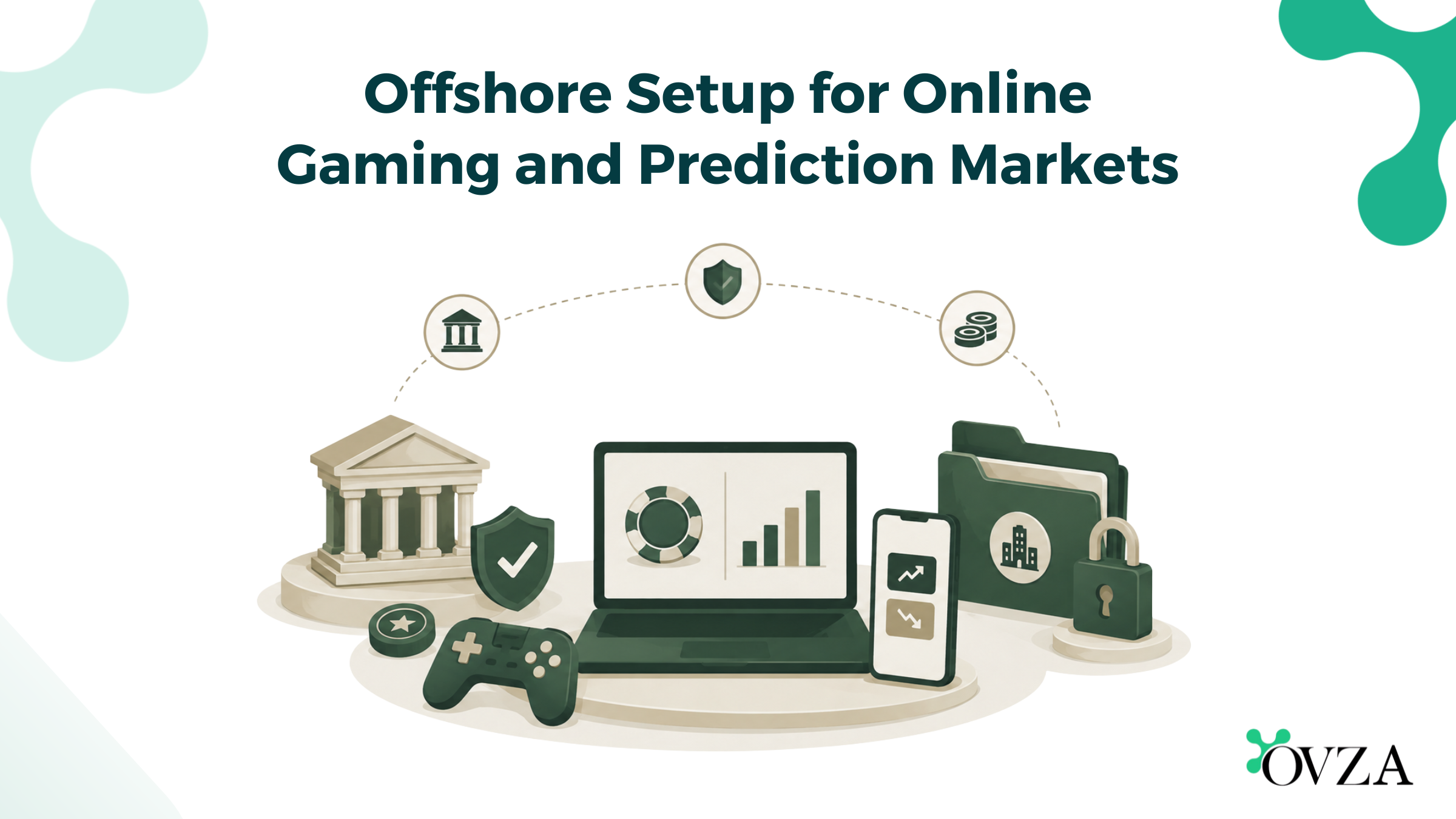
The online gaming industry has developed into a highly international business sector encompassing casinos, sportsbooks, gaming platforms, esports-related wagering, and emerging prediction-market models. Operators may work with software providers, payment institutions, affiliates, customers, and commercial partners across multiple jurisdictions.
For founders entering this sector, the corporate structure is an important part of the overall business model. Ownership of intellectual property, operating activities, licensing arrangements, payment relationships, and management functions may all need to be considered when building an international gaming business.
Under modern international gaming regulatory compliance 2026 standards, an offshore setup for online gaming and prediction markets can provide a structured corporate framework for businesses operating across international markets.
However, incorporation alone does not provide permission to conduct regulated gaming or financial activities. Licensing requirements depend on the nature of the platform, the products offered, the jurisdiction of operation, and the markets in which customers are located.
- Why Consider an Offshore Setup for Online Gaming and Prediction Markets?
- Understanding the Corporate Structure
- Gaming Structure vs. Prediction-Market Structure
- Structuring Intellectual Property and Operations
- Banking and Payment Considerations
- Key Compliance Considerations
- Building an International Gaming Structure
- Заключение
Why Consider an Offshore Setup for Online Gaming and Prediction Markets?
International gaming businesses often require more than a single operating company. A carefully designed corporate structure can separate ownership, intellectual property, operating functions, and treasury activities while creating a clearer framework for regulatory compliance.
An appropriate structure may allow a business to separate its intellectual property from its day-to-day gaming operations, establish the operating entity around the applicable licensing framework, and organize international payment relationships through suitable financial institutions. Software, trademarks, domains, and other intellectual property may also be held separately where legally and commercially appropriate.
The objective is not simply to establish an offshore entity. The objective is to create a legally appropriate corporate architecture that supports the business’s licensing, banking, technology, and international expansion requirements.
Understanding the Corporate Structure
When considering an offshore setup for online gaming and prediction markets, the appropriate structure depends heavily on the actual activity being conducted.
1. Gaming Operating Entities
An online casino, sportsbook, or other gaming platform may operate through a dedicated company responsible for the commercial activity.
Depending on the jurisdiction and business model, the operating company may need an appropriate gaming authorization before offering regulated services. Licensing requirements can include corporate documentation, ownership disclosures, AML/KYC procedures, responsible-gaming policies, technical controls, and ongoing reporting obligations.
The corporate entity therefore needs to be designed around the applicable regulatory framework rather than incorporated independently of it.
2. Technology and Intellectual Property Entities
Gaming businesses often possess valuable software, trademarks, domains, platform technology, and other intellectual property.
Where appropriate, these assets can be held separately from the operating business. A dedicated IP entity can then license relevant technology or brand assets to an operating company under documented commercial agreements.
This can provide clearer ownership and contractual separation, although the structure should reflect applicable intellectual-property, tax, transfer-pricing, and regulatory requirements.
3. Prediction-Market Structures
Prediction markets require particularly careful regulatory analysis.
Some prediction-market products involve contracts whose value depends on the outcome of future events. Depending on their structure and the markets served, these products may be treated as gaming products, derivatives, event contracts, or another regulated financial activity.
For example, in the United States, the CFTC describes event contracts as derivative contracts whose payoff is based on specified events and states that prediction markets can fall under the Commodity Exchange Act.
This means that a prediction platform should not assume that an ordinary offshore company or gaming license automatically authorizes its activities. The underlying product, customers, settlement mechanism, and jurisdictions involved all need to be assessed.
Gaming Structure vs. Prediction-Market Structure
| Structural Area | Online Gaming Business | Prediction-Market Business |
| Primary Activity | Casino, sportsbook, gaming, or related services | Trading or settlement of event-based contracts |
| Регулятивный фокус | Gaming and gambling regulation | Potential financial, derivatives, or gaming regulation |
| Operating Entity | May require a licensed gaming operator | May require authorization appropriate to the product |
| Право собственности на интеллектуальную собственность | Software, trademarks, platform technology | Software, trading infrastructure, trademarks, technology |
| Customer Compliance | AML/KYC and responsible-gaming requirements may apply | Customer identification and financial-market requirements may apply depending on the structure |
| Доступ к рынку | Often depends on permitted territories and gaming rules | Depends on the applicable financial or gaming framework |
| Payment Relationships | Merchant acquiring, payment processing, and banking | Banking, payment processing, and potentially regulated financial infrastructure |
This distinction is particularly important in 2026 because prediction-market regulation continues to develop. The CFTC has been actively examining the regulatory framework surrounding event contracts and prediction markets, including proposals concerning contracts related to gaming and other enumerated activities.
Structuring Intellectual Property and Operations
One potential approach is to separate the business into distinct functional layers:
IP Holding Entity → Operating Entity → Payment & Commercial Infrastructure
The IP entity may own trademarks, software, domains, and other technology.
The operating company may conduct the licensed gaming or platform activity.
Payment and treasury arrangements can then be established according to the requirements of the operating jurisdiction, payment providers, and financial institutions. This separation can provide greater visibility over which company owns particular assets and which entity assumes particular commercial responsibilities.
It should not, however, be treated as a method of avoiding licensing or regulatory obligations. Each entity must have a legitimate business purpose and operate consistently with applicable law.
Banking and Payment Considerations
Payment infrastructure is an important part of any international gaming business.
Gaming-related businesses can face enhanced due diligence from banks, payment processors, and electronic money institutions because of the regulated nature of the sector. Providers may request corporate formation documents, beneficial ownership information, applicable gaming or financial licenses, business plans, AML/KYC procedures, responsible-gaming policies, evidence of source of funds, and information about the platform and its target markets.
Maintaining complete and well-organized corporate and compliance documentation can make the onboarding process more straightforward, although approval always remains subject to the individual bank or payment provider’s policies.
Key Compliance Considerations
An offshore structure should form part of a broader compliance framework rather than being viewed as a substitute for regulation.
Licensing: The business should first determine whether its activities require gaming, financial, virtual-asset, or another form of authorization based on the products offered and markets targeted.
AML and KYC: Depending on the regulatory framework, customer identification, transaction monitoring, source-of-funds procedures, and suspicious-activity controls may form part of the operating requirements.
Responsible Gaming: Gaming operators may need appropriate policies covering age verification, player protection, responsible wagering, advertising, and self-exclusion.
Geographic Restrictions: An authorization in one jurisdiction does not necessarily permit an operator to accept customers everywhere. The laws and restrictions of individual target markets must be considered separately.
Tax and Reporting: Corporate tax, gaming taxes, withholding taxes, VAT/GST, transfer pricing, and reporting obligations can vary depending on the corporate structure and jurisdictions involved.
Building an International Gaming Structure
Rather than treating incorporation as the final objective, international gaming founders should approach the process as a coordinated corporate and regulatory exercise. The first step is to define the business model, whether it involves an online casino, sportsbook, gaming platform, prediction market, or related technology service.
The business should then assess the licensing and regulatory requirements applicable to its products, customers, and target markets. Once these requirements are clear, the corporate structure can be designed to determine which entities should own intellectual property, conduct operations, enter commercial agreements, and manage treasury functions. Appropriate banking and payment infrastructure can then be established using the corporate and compliance documentation required by financial institutions and payment providers.
Finally, maintaining current corporate records, ownership information, licenses, AML/KYC procedures, financial records, and regulatory filings ensures that the structure remains aligned with ongoing compliance requirements.
Заключение
An offshore setup for online gaming and prediction markets can provide an organized corporate foundation for businesses operating across international markets. The most effective structures go beyond simple incorporation by considering ownership, intellectual property, licensing, payments, governance, and ongoing compliance together.
For online gaming operators, the appropriate corporate structure can help separate commercial activities from valuable intellectual property and create a clearer framework for international operations. For prediction-market businesses, careful regulatory classification is particularly important because event-based contracts may fall within financial or derivatives regulation rather than traditional gaming regulation.
A well-planned international structure allows gaming and technology businesses to approach global expansion with greater clarity while keeping corporate responsibilities, regulatory requirements, and commercial relationships properly organized.

Добавьте OVZA в список рекомендуемых источников Google.
Сделайте OVZA своим предпочтительным источником, чтобы легко получать доступ к нашим последним аналитическим материалам, исследованиям и проверенной информации непосредственно через Google.

Предупреждение: Информация, представленная на этом веб-сайте, предназначена только для общего ознакомления и образовательных целей. Несмотря на все усилия OVZA по обеспечению точности и актуальности информации, ее содержание не следует рассматривать как юридическую, финансовую или налоговую консультацию.