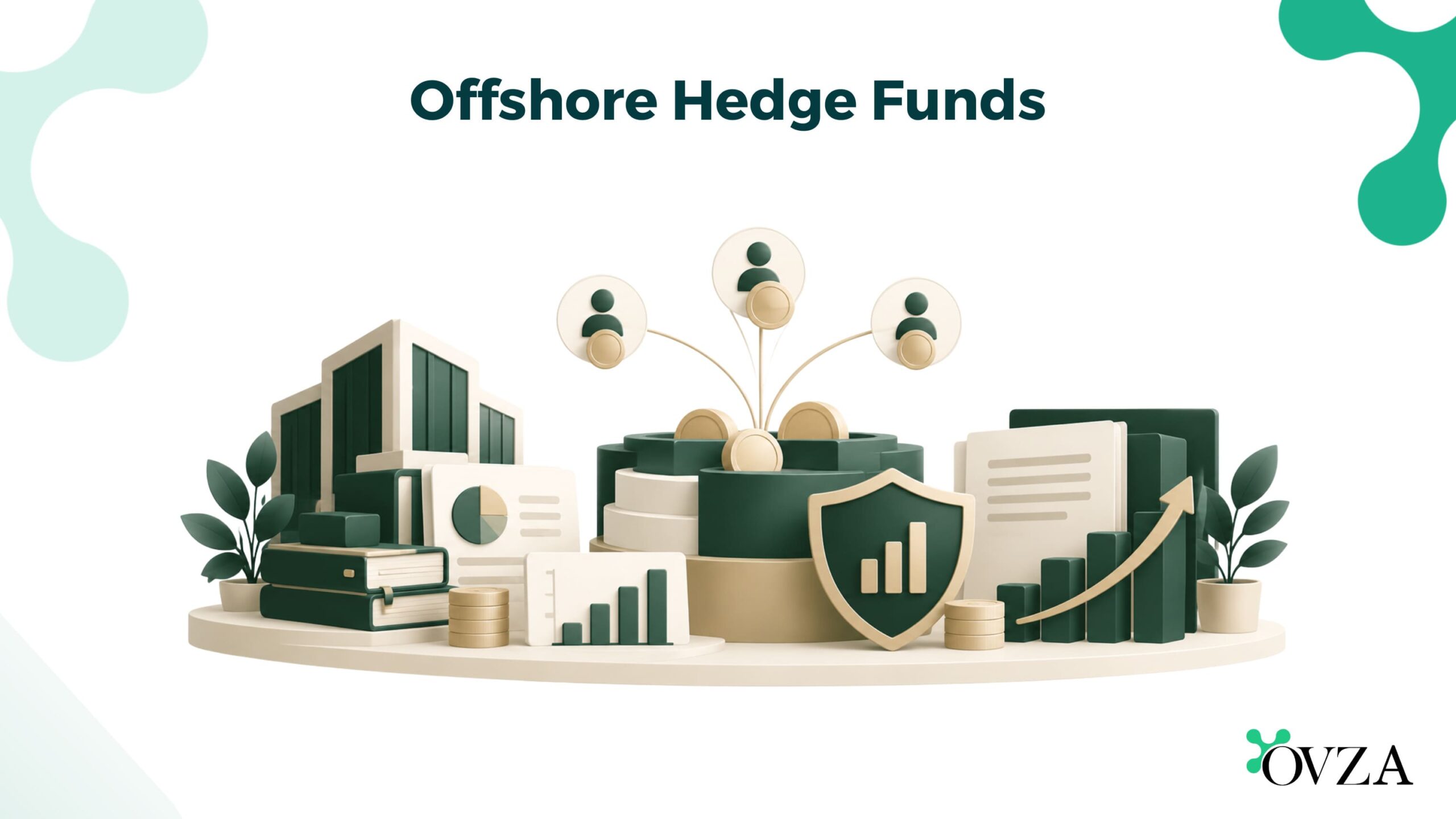
The international alternative investment landscape has evolved rapidly, driven by cross-border capital flows and sophisticated portfolio management strategies. Offshore hedge funds have established themselves as premier collective investment vehicles, allowing fund sponsors to pool global capital efficiently while deploying active investment strategies across international markets. Operating within globally recognized, tax-neutral jurisdictions, these funds provide the operational foundation for investment managers pursuing equities, quantitative trading, fixed income, digital assets, and multi-asset strategies.
At their core, offshore hedge funds are private pooled investment vehicles organized under the company, partnership, or trust legislation of an international financial center. Unlike conventional retail mutual funds, hedge funds cater to institutional investors, family offices, sovereign wealth funds, and high-net-worth individuals. They offer managers the legal flexibility to deploy non-traditional investment methodologies, including long-short equity allocations, algorithmic leverage, derivatives hedging, and concentrated directional investments.
Establishing an investment fund in a premier offshore jurisdiction resolves many of the friction points associated with multi-jurisdictional fundraising. When investment managers raise capital from investors based in different tax territories, routing all capital through an onshore vehicle can expose foreign investors to unnecessary domestic tax filing requirements, dividend withholding taxes, and local regulatory restrictions. Offshore funds eliminate this friction by creating an efficient, tax-neutral platform where each investor accounts for returns according to their home tax regime.
Understanding how to structure, license, and launch an offshore hedge fund is essential for emerging managers establishing their first track record as well as institutional sponsors managing multi-billion-dollar strategies. By aligning entity classification, regulatory licensing, and service provider ecosystems from the outset, fund managers preserve operational continuity, ensure investor confidence, and accelerate time-to-market across global capital markets.
Strategic Drivers and Global Investor Alignment
The foundational advantage of establishing an offshore hedge fund is tax neutrality. Leading offshore fund jurisdictions such as the Cayman Islands, the British Virgin Islands (BVI), and Bermuda do not impose corporate income taxes, capital gains taxes, or dividend withholding taxes at the fund entity level. This fiscal structure ensures that investment returns flow directly through to investors without an intermediate layer of entity-level taxation, allowing domestic and foreign investors to manage their tax liabilities based solely on their individual tax residencies.
A primary driver for launching an offshore fund is the accommodation of non-U.S. investors and U.S. tax-exempt institutions. U.S. tax-exempt entities, such as university endowments, charitable foundations, and pension funds, face significant tax penalties known as Unrelated Business Taxable Income (UBTI) if they invest in leveraged strategies through a standard U.S. domestic partnership. By investing through an offshore corporate entity, these institutions block UBTI attribution, enabling them to participate in leveraged hedge fund strategies without incurring unexpected domestic tax liabilities.
Similarly, international investors residing outside the United States prefer offshore funds to protect themselves from direct exposure to the U.S. Internal Revenue Service. Investing through an offshore corporate feeder ensures that non-U.S. investors avoid U.S. trade or business classification, eliminating the requirement to file U.S. tax returns or pay U.S. withholding taxes on capital gains. This clear structural separation gives global allocators the confidence needed to commit substantial capital to the fund.
Premier offshore financial centers combine this fiscal efficiency with robust regulatory frameworks designed for speed, flexibility, and credibility. Jurisdictions like the BVI and the Cayman Islands operate under British common law, featuring dedicated commercial courts, seasoned judicial benches, and regulatory authorities with deep expertise in fund administration. These jurisdictions offer streamlined launch procedures such as the BVI Incubator and Approved Fund regimes allowing new managers to test strategies and build operational track records with cost-effective compliance requirements.
Structural Architecture: Master-Feeder, Standalone, and Umbrella Models
The Master-Feeder structure is the gold standard for hedge fund managers raising capital from both U.S. and non-U.S. investors. Under this architecture, a single offshore Master Fund typically established as an exempted company or partnership in the Cayman Islands or the BVI executes all portfolio trading, holds all assets, and manages prime brokerage accounts. Capital flows into the Master Fund from two separate “feeder” entities: an onshore U.S. limited partnership for taxable domestic investors and an offshore corporate feeder for non-U.S. and U.S. tax-exempt investors.
This master-feeder configuration delivers exceptional operational and cost efficiencies. By centralizing all trading activities within the Master Fund, the investment manager eliminates the operational burden of executing duplicate trades, maintaining split tax lots, and managing separate broker margin accounts across multiple portfolios. Profits, losses, and management fees are allocated proportionally back to the feeder funds based on their capital contributions, preserving equal performance treatment for all investors while tailoring tax reporting to each group’s legal status.
For managers targeting capital exclusively outside the United States, a Standalone Offshore Fund offers a simpler, cost-effective alternative. Structured as an open-ended investment company, a standalone fund issues redeemable shares directly to non-U.S. and institutional investors without requiring an accompanying U.S. partnership feeder. Conversely, managers launching with a predominantly domestic investor base often utilize a “mini-master” structure, where an offshore corporate feeder invests directly into an onshore U.S. operating fund, lowering early legal and administrative setup costs.
Managers pursuing multi-strategy portfolios, variable liquidity terms, or distinct asset classes frequently utilize Segregated Portfolio Companies (SPCs). An SPC is a single legal entity that creates statutory “cells” or segregated portfolios, each with legally ring-fenced assets and liabilities. This structure allows a sponsor to operate different investment strategies such as traditional long-short equities in one portfolio and digital assets or private credit in another under a single umbrella corporate structure, preventing cross-liability risks while significantly reducing administrative overhead.
Key Service Providers and Operational Governance
Operating an offshore hedge fund requires a coordinated ecosystem of independent service providers to ensure regulatory compliance, accurate asset valuation, and investor protection. The Fund Administrator plays a central role by managing independent Net Asset Value (NAV) calculations, maintaining the fund’s official share registry, issuing investor statements, and conducting anti-money laundering (AML) and Know Your Customer (KYC) onboarding checks. Appointing an independent, reputable fund administrator is a universal prerequisite for institutional allocators conducting operational due diligence.
Asset custody, trade execution, and financing infrastructure are handled by tier-one Prime Brokers and Custodians. The prime broker provides margin financing, securities lending, centralized trade clearing, and order execution, while dedicated custodians maintain physical and digital custody of fund assets. Ensuring that investor capital and portfolio securities are held with independent, regulated custodians protects fund property and reassures investors that assets are safe and segregated from the manager’s balance sheet.
Corporate governance standards in leading offshore jurisdictions place significant emphasis on the role of the fund’s Board of Directors. Regulatory authorities and institutional investors generally expect funds to appoint independent directors with proven fund administration, legal, and risk management backgrounds. These independent board members provide objective fiduciary oversight, supervise conflicts of interest between the investment manager and the fund, review financial statements, and ensure that the vehicle operates in strict compliance with its offering documents.
The operational foundation is completed by legal counsel, statutory auditors, and licensed registered agents. Fund legal counsel drafts the offering memorandum, constitutional documents, and subscription agreements, navigating licensing applications with regulatory bodies like the Cayman Islands Monetary Authority (CIMA) or the BVI Financial Services Commission (FSC). Approved independent audit firms conduct annual statutory audits, while the local registered agent maintains the fund’s registered office, coordinates annual government filings, and manages official regulatory correspondence.
Comparative Overview of Offshore Fund Frameworks
Selecting the appropriate jurisdiction and fund vehicle depends on the investment manager’s assets under management (AUM), target investor base, asset class, and fundraising timeline. While the Cayman Islands remains the dominant global hub for multi-billion-dollar institutional master-feeder funds, the British Virgin Islands offers innovative, cost-efficient regimes tailored for emerging managers and mid-market funds. Evaluating these regulatory vehicles early ensures the fund launches smoothly and scales efficiently over its lifecycle.
Each offshore framework balances speed-to-market, regulatory requirements, service provider mandates, and launch expenditures differently. Understanding these distinctions allows fund sponsors to choose a structure that matches their capital resources and strategic vision. The matrix below outlines the primary operational vectors, regulatory parameters, and structural benefits across leading offshore hedge fund formats:
| Fund Model & Jurisdiction | Target Investor Profile | Regulatory Framework & Limits | Primary Structural Benefit | Typical Launch Window |
| Cayman Master-Feeder Fund | Global institutional, U.S. taxable & U.S. tax-exempt allocators | CIMA registered under Mutual Funds Act; audit & administrator required | Centralized trading, maximum institutional acceptance, zero UBTI drag | 4 to 8 weeks |
| BVI Incubator Fund | Sophisticated investors, friends, family & seed capital | BVI FSC approved; max 20 investors, max $20M AUM; 2-year term limit | Minimal initial setup cost; no mandatory administrator or auditor required | 2 to 5 business days |
| BVI Approved Fund | Private wealth networks, family offices & close associates | BVI FSC approved; max 20 investors, max $100M AUM; evergreen duration | Low operational overhead; requires administrator, audit exempt | 2 to 5 business days |
| Cayman Registered Fund | Qualified institutional & high-net-worth investors | CIMA registered; minimum $100,000 initial investment per investor | Global brand recognition; proven path for scalable institutional growth | 3 to 6 weeks |
| Segregated Portfolio Co. (SPC) | Multi-strategy, digital assets, or bespoke share class investors | Available in Cayman & BVI; individual cells ring-fenced by statute | Run diverse strategies & asset classes under one umbrella vehicle | 4 to 7 weeks |
Conclusion
Launching an offshore hedge fund provides investment managers with an agile, tax-neutral platform designed to raise capital globally and execute advanced trading strategies with confidence. By leveraging established structures like master-feeders, standalone open-ended companies, or segregated portfolio vehicles, sponsors protect investor interests while maintaining compliance with international regulatory standards. A well-executed fund launch sets the stage for institutional growth, seamless banking relationships, and sustainable long-term performance.
Navigating the cross-border legal, administrative, and compliance requirements of an offshore fund requires experienced corporate secretarial guidance and trusted local representation. Partnering with knowledgeable offshore governance professionals ensures that registered office duties, statutory registers, director appointments, and annual regulatory filings are handled smoothly.

Add OVZA to Google Preferred Sources
Make OVZA your preferred source to ensure you can easily discover our latest insights, research, and trusted content directly through Google.

Disclaimer: The information provided on this website is intended for general reference and educational purposes only. While OVZA makes every effort to ensure accuracy and timeliness, the content should not be considered legal, financial, or tax advice.