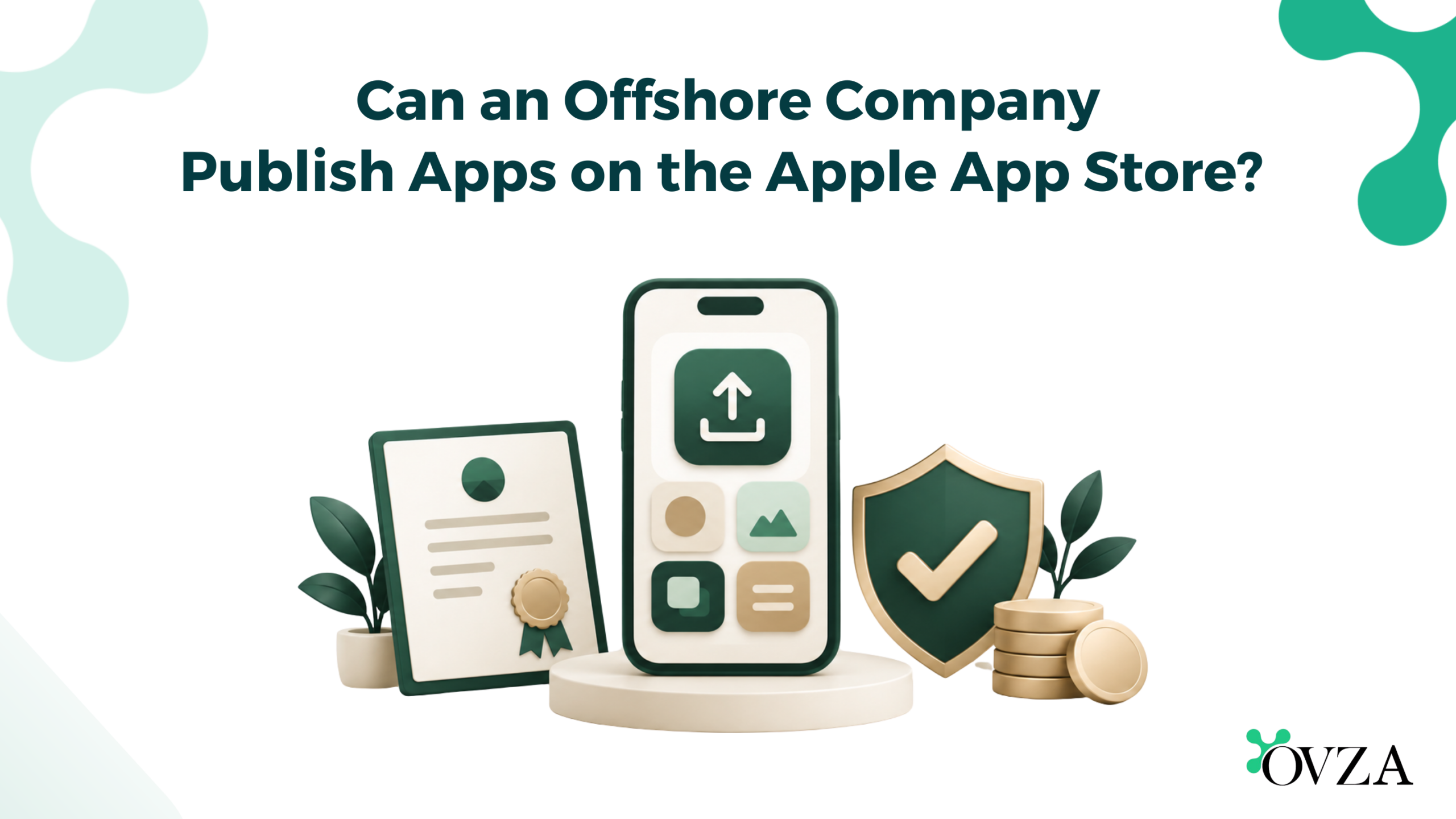
Yes, an offshore company can publish apps on the Apple App Store, provided it meets Apple’s requirements for organizational enrollment.
For independent app developers and international software businesses, registering an offshore company can offer several advantages, including the ability to publish applications under a corporate name rather than a personal name, receive international App Store revenue, and operate through a separate legal entity.
However, before an offshore company can enroll in the Apple Developer Program, it must satisfy certain verification requirements, including obtaining a D-U-N-S Number and providing accurate, verifiable company information.
In this article, we explore the requirements for publishing apps on the Apple App Store through an offshore company, the benefits of doing so, and two suitable jurisdictions for offshore company registration: the British Virgin Islands (BVI) and The Bahamas.
Requirements for Registering an Offshore Company on the Apple App Store
To publish apps on the Apple App Store, an offshore company must enroll in the Apple Developer Program as an organization and satisfy Apple’s corporate verification requirements. These requirements are intended to establish the company’s legal existence, verify its business details, and confirm that the applicant is authorized to represent it.
1. Obtain a D-U-N-S Number
An offshore company must obtain a D-U-N-S Number, a unique nine-digit business identification number issued by Dun & Bradstreet (D&B).
Apple uses the D-U-N-S Number to verify the offshore company’s legal identity, corporate status, and registered business information. Companies without an existing D-U-N-S Number can generally request one free of charge through Apple’s official D-U-N-S lookup service.
The company’s legal name and address must be accurately reflected in Dun & Bradstreet’s records to avoid complications during enrollment.
2. Provide a Verifiable Business Address
An offshore company must provide its headquarters address when registering for the Apple Developer Program. The address must accurately reflect the company’s business details and be capable of verification.
A P.O. Box alone should not be relied upon as the company’s verifiable business address. All offshore companies registered through OVZA are provided with a registered address that is not a P.O. Box, meaning this particular requirement should not present an issue for our clients, provided the address satisfies Apple’s verification requirements.
3. Provide Proof of Address
During the verification process, Apple or Dun & Bradstreet may request additional documentation to confirm the offshore company’s identity and business address.
One potential form of supporting evidence is a corporate bank statement displaying the offshore company’s legal name and address, although acceptance depends on the verification requirements applicable to the company.
When incorporating an offshore company through OVZA, clients who select our Standard Package benefit from one corporate bank account application, while those who select our Premium Package benefit from up to five corporate bank account applications, with the process concluding upon the first successful approval. Once the bank account is approved and activated, the bank may issue statements displaying the company’s legal name and verified address, which can serve as supporting documentation during the verification process.
4. Satisfy Additional Apple Developer Requirements
In addition to obtaining a D-U-N-S Number and providing accurate company information, an offshore company must meet several other enrollment requirements, including:
- Having a legally incorporated entity capable of entering into agreements.
- Maintaining a functional, publicly accessible company website.
- Providing a business email address associated with the company’s domain.
- Appointing an individual with legal authority to enter into agreements on the company’s behalf.
- Completing Apple’s identity verification and enrollment procedures.
Once the offshore company has successfully completed verification, it can proceed with its Apple Developer Program membership, which generally costs USD 99 annually, and begin publishing applications under its corporate name.
Benefits of Publishing Apps on the Apple App Store Through an Offshore Company
Registering an offshore company to publish applications on the Apple App Store can offer significant advantages to independent developers, software entrepreneurs, and international technology businesses. From favorable tax regimes to greater privacy and intellectual property protection, offshore incorporation can provide a practical foundation for operating an international app development business.
The commercial opportunities available to app developers have grown considerably in recent years. According to a study conducted by economists at Analysis Group and published by Apple in June 2026, the global App Store ecosystem facilitated over USD 1.4 trillion in developer billings and sales during 2025, including USD 149 billion attributable to digital goods and services. With the App Store reaching more than 850 million users on average each week across 175 countries and regions, app development has become an increasingly international business. For developers seeking to participate in this market, establishing an offshore company can provide a corporate structure through which to manage their applications, intellectual property, and international revenue.
Developer billings & sales
Facilitated globally by the App Store ecosystem in 2025
Physical goods
and services
Digital goods
and services
In-app
advertising
Average weekly users
Countries and regions
Of billings and sales involved no commission paid to Apple
Growth since 2019
Consumer-facing AI apps
4x more growthIn billings during 2025
The scale of the App Store ecosystem highlights the commercial opportunity available to app developers worldwide.
1. Tax Advantages
One of the most attractive benefits of registering an offshore company for Apple App Store publishing is the potential to operate under a favorable corporate tax regime.
OVZA offers company formation in numerous offshore jurisdictions, many of which provide full exemptions from local corporate income tax on qualifying business activities. In certain jurisdictions, offshore companies may also benefit from exemptions from other direct taxes, subject to the applicable legislation and the nature of their operations.
For developers generating revenue through paid applications, subscriptions, advertisements, or in-app purchases, establishing a company in a tax-efficient jurisdiction can present a significant commercial advantage. This is particularly relevant to independent developers operating internationally, who may have customers across dozens of countries without necessarily maintaining a physical office in any of them.
It is important, however, to distinguish between a company’s local tax treatment and the tax obligations of its shareholders. An offshore company may still be subject to taxation in other jurisdictions depending on where it is managed, where its activities are conducted, and the tax residence of its owners.
2. Publish Applications Under a Corporate Name
When registering for the Apple Developer Program as an individual, Apple generally displays the developer’s personal legal name as the seller of their applications. For independent developers, this may not always be desirable, particularly when building a commercial software brand or publishing multiple applications. By registering an offshore company and enrolling in the Apple Developer Program as an organization, developers can instead have their company’s registered legal name displayed as the seller on the App Store.
This creates a more professional corporate presence and allows developers to establish a recognizable identity for their applications without displaying their personal names as the seller.
3. Limited Liability Protection
Operating an application business through an offshore company allows developers to separate their commercial activities from their personal affairs.
For example, an application generating revenue through subscriptions or in-app purchases may have contractual obligations towards suppliers, service providers, and other commercial partners. Conducting these activities through a separate legal entity can help limit the personal liability of its shareholders for company obligations, subject to applicable law.
Certain offshore jurisdictions also offer additional legal protections against creditors and potentially frivolous litigation. Nevis, for instance, is particularly well known for its asset protection legislation. Foreign judgments are not automatically enforceable against Nevis companies in the same manner as domestic judgments, meaning creditors may need to initiate separate legal proceedings in Nevis to pursue certain claims.
Nevis legislation governing LLCs and international trusts also contains additional creditor bond provisions, meaning that potential claimants may, in certain proceedings, be required to deposit a six-figure sum exceeding USD 100,000 simply to initiate legal action against a Nevis entity, depending on the applicable legislation and the court’s requirements.
These protections can provide an additional layer of legal certainty for developers seeking to safeguard their business interests, although they do not prevent legitimate claims or make offshore companies immune from litigation.
4. International Banking and Revenue Collection
Developers publishing applications on the Apple App Store may generate revenue from customers across numerous countries. Having a dedicated corporate bank account can make managing these revenues considerably more straightforward.
An offshore company can apply for an international corporate bank account through which it may receive eligible App Store payouts, pay software developers and contractors, and cover other business expenses. Separating company revenue from personal finances also facilitates financial recordkeeping and makes it easier to manage multiple applications under the same corporate structure.
While offshore incorporation does not automatically guarantee access to international banking services, OVZA offers corporate bank account application assistance as part of its Standard and Premium incorporation packages.
5. Intellectual Property Ownership and International Trademark Protection
For many app developers, the most valuable assets of their business are not physical assets, but their applications, source code, trademarks, and other intellectual property.
Registering an offshore company allows these assets to be held under a separate corporate entity rather than personally by the developer. This can be particularly useful when entering licensing agreements, attracting investors, collaborating with other developers, or eventually selling an application or software business. Developers may also choose to register their application’s name or brand as a trademark in the name of their offshore company, providing an additional layer of protection for their intellectual property.
Depending on the jurisdiction and the company’s eligibility, it may also be possible to use the World Intellectual Property Organization (WIPO) Madrid System to seek trademark protection in multiple countries through a single international application based on an existing national or regional trademark application or registration.
The Madrid System requires a qualifying connection to a member jurisdiction, and international protection is subject to examination in the countries designated. Nevertheless, where available, it can provide a convenient mechanism for developers seeking to protect their application brands internationally.
Best Offshore Jurisdictions for Apple App Store Developers
For developers looking to register an offshore company to publish applications on the Apple App Store, Samoa and Belize are two tax free offshore jurisdictions worth considering. Both offer established corporate frameworks, flexible ownership structures, and opportunities for international entrepreneurs to establish a legal entity through which they can develop, publish, and monetize their applications.
1. Samoa

Governing Legislation: International Companies Act 1988
Samoa has long been an established offshore financial centre, offering international companies a favorable legal and regulatory environment. Companies incorporated under the International Companies Act 1988 benefit from a particularly attractive tax regime, including broad exemptions from local taxation, subject to the applicable statutory provisions. This makes Samoa an appealing option for independent app developers and software entrepreneurs seeking to establish an international business without incurring unnecessary corporate overhead.
A Samoan International Company can be used to own and manage multiple applications, hold intellectual property, enter into licensing agreements, and receive revenue generated through international software operations. The jurisdiction also provides considerable flexibility in corporate structuring, including the ability to incorporate companies with foreign shareholders and directors, making it suitable for developers operating remotely from different parts of the world.
For developers intending to publish their applications on the Apple App Store, a Samoan International Company can provide the legal corporate structure needed to apply for organizational enrollment. However, the company must still obtain a D-U-N-S Number and satisfy Apple’s verification requirements, including providing accurate corporate information and a verifiable business address.
2. Belize

Governing Legislation: Belize Companies Act 2022
Belize is another attractive jurisdiction for international app developers, particularly those seeking a modern corporate framework with relatively straightforward incorporation and administration requirements.
The Belize Companies Act 2022 introduced a consolidated legal framework governing companies incorporated in the jurisdiction, replacing the former International Business Companies Act. Under this legislation, foreign entrepreneurs can establish Belize companies with flexible ownership and management arrangements, making the jurisdiction suitable for independent developers, software studios, and businesses operating several applications simultaneously.
One of the principal advantages of incorporating in Belize is the ability to establish a separate legal entity through which software intellectual property, commercial contracts, and international revenue can be managed. Rather than personally owning each application and entering into agreements as an individual, developers can centralize these activities under a corporate structure, which may also facilitate future investment, licensing arrangements, or the sale of their software business.
Belize companies may also benefit from favorable tax treatment in certain circumstances, although the jurisdiction does not provide an unconditional exemption from all taxes for every company. The applicable treatment depends on the company’s income, activities, and relevant tax legislation.
For Apple App Store developers, incorporating a Belize company can therefore provide a practical foundation for establishing an international software business. Once incorporated, the company can proceed with obtaining its D-U-N-S Number and preparing the documentation required for enrollment in the Apple Developer Program, subject to Apple’s independent verification and approval.
Conclusion
Registering an offshore company to publish applications on the Apple App Store can provide developers with a range of legal and commercial advantages, from favorable tax treatment and limited liability protection to international banking and intellectual property ownership. Jurisdictions such as Samoa and Belize offer established corporate frameworks through which developers can structure their software businesses, provided they satisfy Apple’s organizational enrollment and verification requirements.
Through OVZA, developers can register an offshore company remotely, obtain the necessary incorporation documents, and benefit from corporate banking assistance under our Standard and Premium packages. Whether you are preparing to launch your first application or already managing a portfolio of successful apps, establishing an offshore company can provide a solid legal foundation for your international software business.

Add OVZA to Google Preferred Sources
Make OVZA your preferred source to ensure you can easily discover our latest insights, research, and trusted content directly through Google.

Disclaimer: The information provided on this website is intended for general reference and educational purposes only. While OVZA makes every effort to ensure accuracy and timeliness, the content should not be considered legal, financial, or tax advice.