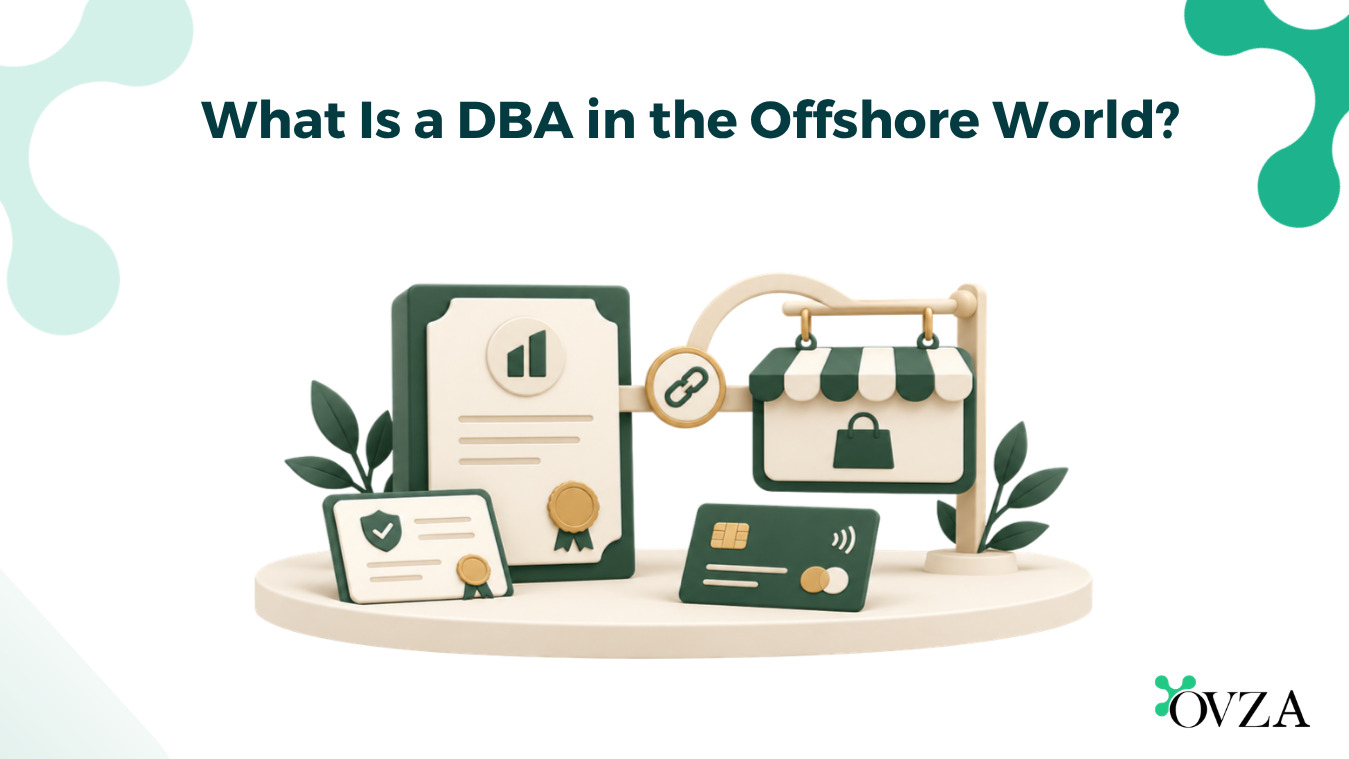
A “Doing Business As” (DBA) variously referred to in international commerce as an assumed business name, trade name, or fictitious business moniker functions as an official trading alias for a properly chartered corporation. In standard commercial practice, it allows an established company to conduct market-facing operations, execute vendor agreements, and collect client payments under a focused brand name that differs from its registered legal charter name.
In the offshore corporate sphere, using a trade name represents a highly practical strategy for market expansion. Global entrepreneurs frequently establish an international entity in a premier jurisdiction, such as the Cook Islands, Nevis, or the British Virgin Islands, to secure robust corporate privacy, statutory asset protection, and flexible governance. However, the commercial operations of these enterprises frequently demand relatable, recognizable brand names to build credibility with customers across consumer-dense hubs in North America, Europe, and Asia.
A trade name bridges these legal and commercial requirements. It enables an international parent corporation to run localized digital storefronts, specialized software platforms, or boutique advisory practices under distinct trade monikers without the expense and ongoing administrative burden of incorporating separate legal entities for every project.
The offshore market addresses the need for operational trade aliases through three main avenues. Some jurisdictions enact specific statutory business names legislation that governs the formal registration of trading styles. Others provide for dual foreign character names, which allow corporations to record secondary non-Latin names directly on their constitutional charter. Additionally, companies frequently register foreign assumed names within target consumer markets, allowing the offshore parent to interface directly with domestic payment rails.
Throughout these implementations, an assumed name never creates an independent legal person. A trade name holds no separate corporate capacity, maintains no independent board, and provides no standalone liability shield. The legal personality remains centered in the parent entity, meaning the underlying offshore company remains the legal foundation for all contracts, assets, and operational responsibilities.
Statutory Trade Name Architecture Across Premier Offshore Hubs
Different offshore corporate domiciles provide specific statutory mechanisms that allow companies to adopt alternative business names with full regulatory transparency.
Under Section 11 of the BVI Business Companies Act,a business company may register an official foreign character name alongside its primary English legal name.This provision is commonly used by enterprises operating across Asian and Middle Eastern financial markets,as it allows non-Latin scripts,such as Chinese or Arabic characters,to appear on the official Certificate of Incorporation.The foreign character name holds legal status equivalent to the Roman-character name,allowing the company to open accounts,execute deeds,and enter commercial ventures under either authorized moniker.The Cayman Islands Companies Act contains parallel statutory dual-name provisions under Sections 30 and 31,allowing international exempted companies to present recognized secondary names to regional markets and institutional counterparties.
In traditional common-law domiciles like the Cook Islands and Nevis,Statutory trade name mechanics are governed by dedicated Registration of Business Names legislation.An International Business Company or Limited Liability Company submits a formal declaration to the corporate registry detailing its legal corporate name,its proposed trading style,and the precise commercial activities conducted under that name.Once processed,the registrar issues a Certificate of Registration of Business Name,providing official proof that links the market-facing brand name directly to the offshore entity.
Other jurisdictions within the Commonwealth tradition rely on common-law “trading as” conventions.Under this approach,an offshore entity adopts a commercial trading name by recording an internal board resolution and disclosing its formal corporate parentage on official business correspondence,invoices,and digital platforms.This ensures complete transparency with commercial counterparties while giving the business the flexibility to develop tailored market branding.
Expanding into Onshore Consumer Markets with an Offshore Parent
One of the most effective strategies for international e-commerce operators,software-as-a-service providers,and cross-border consultants is registering an onshore assumed business name under an offshore parent entity.This architecture pairs the asset insulation and tax neutrality of an international corporate foundation with an accessible commercial presence in major consumer markets.
Customers engage with a polished,market-appropriate brand during checkout,on customer invoices,and across marketing campaigns,which fosters trust and improves sales conversions.Concurrently,all underlying commercial revenues,intellectual property rights,and commercial agreements remain secured within the international parent entity,streamlining global governance and protecting balance-sheet assets.
To implement this cross-border structure,an enterprise incorporated in an offshore domicile completes a foreign qualification or assumed business name filing in an onshore jurisdiction,such as Delaware,Wyoming,or the United Kingdom.This creates an accessible public record confirming that the consumer brand is an authorized trading style of the offshore parent.This transparency satisfies merchant acquiring processors,marketplace facilitators,and institutional banking partners,allowing the enterprise to deploy local payment rails smoothly without compromising its international legal structure.
Banking Integration, Merchant Gateways, and Payment Processing
Connecting an offshore company to modern payment infrastructure,such as Stripe,PayPal,or international merchant acquiring banks,requires clear documentation of all operating trade names.Financial institutions and card processing networks must satisfy Know Your Customer and Anti-Money Laundering mandates,meaning they need to verify the link between the corporate applicant and the business name displayed to consumers.
When a company operates under an informal,undocumented brand name,incoming client remittances often trigger compliance holds due to payee name mismatches.Formalizing a trade name eliminates this operational delay.When setting up merchant accounts or international corporate bank accounts,an offshore enterprise provides an integrated documentation package to bypass these hurdles.
Provides evidence that the offshore company is active and remains in good standing with the relevant corporate registry.
Corporate StatusIdentifies the company's current directors, officers, or other persons authorized to act on its behalf.
Authorized RepresentativesDocuments the relationship between the registered trading name and the company operating behind it.
DBA–Company LinkRecords the company's formal authorization to adopt and use the trading name in business.
Corporate AuthorizationWhen a DBA is properly documented, banks and payment processors can more easily establish the relationship between the trading brand and its legal owner. This helps reduce verification delays and payment-name mismatches, although account approval remains subject to the provider's compliance checks.
Documentation requirements vary by jurisdiction and financial institution. Not every provider requires every document listed above.
This package typically includes a Certificate of Good Standing verifying that the offshore parent company is active,a Certificate of Incumbency identifying the managing directors and officers,an official Trade Name Certificate issued by the appropriate registry,and a formal Board Resolution authorizing the adoption of the trade name for commercial transactions.
From a global tax reporting perspective,a trade name shares the parent company’s tax identification.Under international reporting systems like the Common Reporting Standard and the Foreign Account Tax Compliance Act,financial accounts are categorized under the corporate name and Tax Identification Number of the parent entity.When completing withholding certificates such as U.S.Form W-8BEN-E,the corporate legal name is stated on the primary entity line,while the registered trade name is identified as the operating style,ensuring uninterrupted processing across international payment networks.
Conclusion
Adopting a trade name within an offshore corporate structure offers global businesses an agile path to scaling consumer-facing brands while preserving the structural advantages of an international corporate foundation.Rather than fracturing resources across multiple uncoordinated corporate entities,entrepreneurs can consolidate governance,treasury management,and legal defense within a single,secure international parent.
This unified approach allows enterprises to test new products,launch targeted service lines,and enter foreign markets quickly.By maintaining transparent statutory registers,executing commercial contracts with proper disclosures,and securing core brand trademarks,international companies achieve the ideal balance between customer trust and sovereign asset protection.
Coordinating the corporate,banking,and registry requirements of cross-border trade names is made simple by working with seasoned corporate fiduciaries.Experienced advisors ensure that statutory filings are completed accurately,corporate books remain in Good Standing,and merchant onboarding documentation packages are assembled smoothly.

Add OVZA to Google Preferred Sources
Make OVZA your preferred source to ensure you can easily discover our latest insights, research, and trusted content directly through Google.

Disclaimer: The information provided on this website is intended for general reference and educational purposes only. While OVZA makes every effort to ensure accuracy and timeliness, the content should not be considered legal, financial, or tax advice.