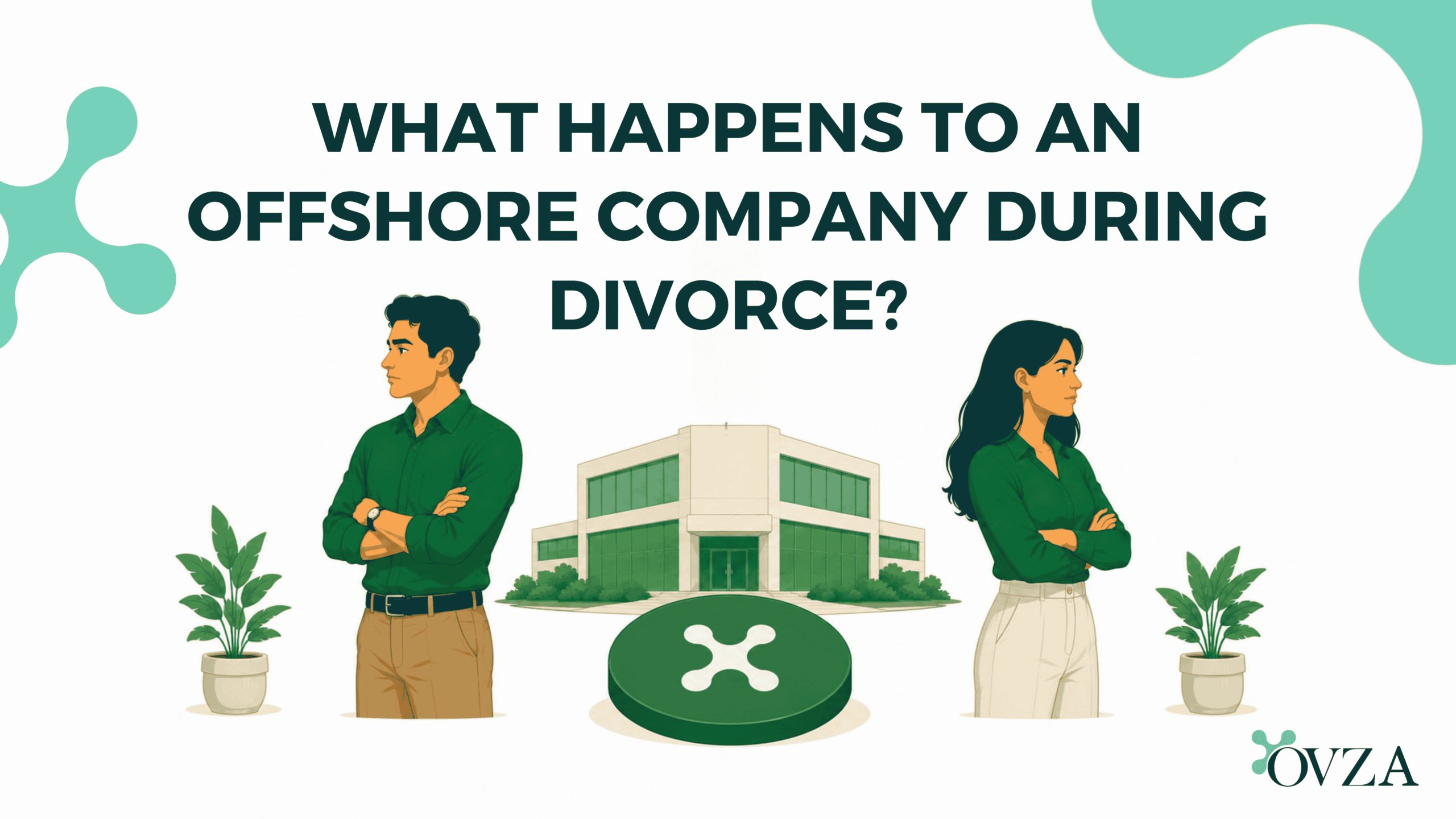
Offshore companies can provide significant protection during divorce proceedings, particularly when they form part of a properly structured international asset protection strategy.
Contrary to popular belief, offshore structures are not designed to hide assets or circumvent the law. Rather, they are legitimate legal vehicles used by entrepreneurs, investors, and high-net-worth individuals to hold assets, separate business interests from personal affairs, and create long-term wealth preservation structures.
When a divorce occurs, the treatment of an offshore company will depend on several factors, including when the structure was established, the jurisdiction involved, the source of the assets held by the company, and whether additional structures such as trusts or foundations have been implemented.
In many cases, a properly established offshore company presents significantly greater challenges than personally owned assets. Where assets are held through an international corporate structure, particularly one that has existed for many years and was established for legitimate commercial or investment purposes, courts frequently encounter practical, legal, and jurisdictional limitations that do not arise with domestically held assets.
This is one of the reasons why offshore companies have long been used as part of broader asset protection and succession planning strategies by business owners around the world.
Why Timing Matters
Perhaps the single most important factor in determining how an offshore company will be treated during divorce proceedings is the timing of its creation. Across numerous legal systems, courts are generally more sceptical of structures established after marital difficulties arise than those created years before any dispute existed.
This distinction is rooted in a long-standing principle of equity found in many jurisdictions. Courts are often willing to respect legitimate wealth planning arrangements, but they are considerably less sympathetic when they believe a structure was established primarily to frustrate the rights of a spouse. Consequently, an offshore company that has existed for ten or twenty years as part of a genuine business or investment strategy will typically be viewed very differently from a company incorporated shortly before separation proceedings begin.
Contrast this with a situation where an individual transfers substantial assets into a newly formed offshore company after becoming aware that a divorce is imminent. Courts frequently scrutinise such transactions closely. Depending on the jurisdiction, judges may examine whether the transfer constituted a fraudulent conveyance, a transaction at an undervalue, or an attempt to defeat an anticipated financial claim. In some cases, courts may even possess statutory authority to unwind certain transactions entirely.
This distinction explains why sophisticated asset protection planning almost always focuses on advance preparation rather than reactive measures. The strongest structures are rarely those created in response to litigation, creditor actions, or marital disputes. Instead, they are structures established during periods of financial stability, when there is no identifiable claimant and no foreseeable dispute.
Timing also affects the evidentiary burden faced by the parties. A company that has existed for many years develops a corporate history. It accumulates board resolutions, banking records, contracts, financial statements, tax filings, and commercial relationships. These records help demonstrate that the structure was established for legitimate purposes independent of any future matrimonial dispute. A newly established entity, by contrast, may struggle to demonstrate such legitimacy.
For this reason, the effectiveness of an offshore structure often depends less on the jurisdiction itself and more on the circumstances surrounding its creation. While jurisdictions such as the Islas Caimán, Nevis, the Cook Islands, Samoa, and the Islas Vírgenes Británicas each possess their own legal advantages, courts frequently focus on the timing, purpose, and substance of the structure rather than its geographic location alone.
As Eli Carter of OVZA’s Legal Affairs Department explains:
“One of the most common misconceptions we encounter is the belief that an offshore company can simply be created when a dispute is already on the horizon. In reality, the strongest asset protection structures are almost always those established long before any claim exists. Courts around the world are generally far more willing to respect legitimate wealth planning arrangements that were created for genuine business, investment, succession, or asset preservation purposes than structures established after marital difficulties have already emerged.”
This principle explains why sophisticated asset protection planning is fundamentally proactive rather than reactive. A properly structured offshore company that has existed for many years, maintained genuine commercial activity, and formed part of a broader wealth preservation strategy may present substantial legal and practical obstacles during divorce proceedings. By contrast, an identical structure established after separation becomes likely or proceedings have already commenced may receive significantly greater judicial scrutiny and, in some circumstances, may provide little meaningful protection at all.
Offshore Companies Are Even Stronger When Combined With Trusts and Foundations
While offshore companies can provide an important degree of separation between an individual and their assets, sophisticated asset protection planning rarely relies upon a company alone. In practice, many high-net-worth individuals, entrepreneurs, and family offices utilise offshore companies as one component of a broader structure that may also include trusts, foundations, private investment vehicles, and succession planning arrangements.
This distinction is important because there is a fundamental difference between owning assets through a company and separating beneficial ownership of those assets altogether.
Where an individual owns all of the shares of an offshore company personally, the ownership interest itself may still form part of that individual’s estate. Although the company’s assets remain legally owned by the company, the shares may possess substantial value and therefore become relevant during divorce proceedings. Courts may encounter difficulties accessing the underlying assets directly, particularly where multiple jurisdictions are involved, but they can often still consider the value of the shareholder’s ownership interest when determining a financial settlement.
The analysis becomes considerably more complex when offshore companies are incorporated into larger wealth preservation structures.
For example, in many international asset protection arrangements, an offshore company may be owned not by the individual directly, but by an offshore trust or private foundation. In such circumstances, the individual may no longer possess direct ownership of the shares. Instead, the structure may be administered by independent trustees, council members, protectors, or other fiduciaries whose legal duties are governed by the laws of a separate jurisdiction.
This separation between legal ownership and beneficial enjoyment has historically formed the foundation of many asset protection strategies. Properly established trusts and foundations can create additional layers of legal complexity that may significantly affect how assets are analysed during divorce proceedings. Questions begin to arise concerning the extent of the beneficiary’s rights, whether distributions are discretionary or fixed, the powers retained by the settlor, and the degree of control that the individual continues to exercise over the structure.
These issues are particularly important because courts generally distinguish between structures that are genuinely independent and those that exist only on paper. If a trust or foundation has been administered properly for many years, possesses independent decision-makers, maintains appropriate records, and operates according to its governing documents, courts may face substantial challenges when attempting to characterise the underlying assets as belonging directly to a divorcing spouse.
This is one of the reasons why our legal affairs department considers trusts and foundations to be among the most powerful tools available for long-term wealth preservation. They are not simply vehicles for holding assets. Rather, they are mechanisms through which ownership, control, management, and beneficial enjoyment may be separated in ways that are often impossible to achieve through personal ownership alone.
| Feature | Empresa extraterritorial | Offshore Company + Trust |
| Ownership of Assets | Assets are owned by the company, but the individual generally owns the shares. | Assets are owned by the company, while the shares are owned by the trust. |
| Connection to the Individual | Direct ownership relationship between shareholder and company. | Additional layer of separation between the individual and the underlying assets. |
| Divorce Proceedings | Courts often focus on the value of the shareholder’s interest in the company. | Courts may need to analyse trust law, beneficiary rights, trustee powers, and company ownership simultaneously. |
| Asset Protection | Provides a meaningful degree of asset separation. | Generally provides a significantly higher level of protection when properly established. |
| Complexity | Relatively straightforward structure. | More sophisticated structure with multiple legal layers. |
| Succession Planning | Limited succession planning benefits. | Often highly effective for multi-generational wealth planning. |
| International Enforcement | May involve cross-border enforcement issues. | Frequently involves multiple jurisdictions and fiduciary relationships. |
| Long-Term Resilience | Strong when established well in advance of any dispute. | Often considered one of the most robust international wealth preservation structures available. |
| Typical Users | Entrepreneurs, investors, and business owners. | High-net-worth individuals, family offices, and long-term wealth preservation strategies. |
| Overall Position During Divorce | Stronger than direct personal ownership. | Potentially substantially stronger than a standalone company structure. |
Many of the world’s most successful entrepreneurs establish their wealth preservation structures during periods of stability rather than during periods of conflict. By the time a dispute eventually emerges, the structure has already developed its own history, governance, commercial rationale, and legal identity. This often places the individual in a significantly stronger position than if the assets had remained under direct personal ownership throughout the marriage.
The Hidden Importance of Jurisdiction Selection
Jurisdiction selection can also play a significant role in determining how resilient an offshore structure ultimately becomes. While no jurisdiction can make assets immune from legitimate legal claims, certain offshore jurisdictions have deliberately enacted legislation designed to discourage speculative, vexatious, or frivolous litigation against international structures established within their borders.
Nevis provides one notable example. Under Nevis law, a party seeking to bring certain actions against a Nevis International Business Company may be required to post a substantial court bond before proceedings can continue. In some circumstances, this bond can amount to as much as USD 250,000.
The practical effect of such provisions is not to prevent legitimate claims from being heard, but rather to ensure that offshore companies are not forced to endure costly litigation based upon weak, speculative, or opportunistic allegations. Legislators in jurisdictions such as Nevis have long recognised that international investors require a stable legal environment in which businesses can operate without being subjected to constant litigation pressure.
As a result, many leading asset protection jurisdictions have developed legal frameworks that seek to balance two competing objectives. On one hand, legitimate claimants must retain access to the courts. On the other hand, offshore structures should not become easy targets for fishing expeditions, nuisance claims, or litigation intended solely to create settlement pressure.
This is one of the reasons why experienced asset protection planners often place significant emphasis on jurisdiction selection. The strength of an offshore structure is not determined solely by the company itself, but also by the legal framework surrounding it. In many cases, the laws governing creditor actions, foreign judgments, evidentiary requirements, and court procedures can be just as important as the structure’s ownership arrangements.
Conclusion
Offshore companies can play an important role in asset protection and wealth preservation strategies, particularly when they are established long before any dispute arises and maintained for legitimate business or investment purposes. While no structure can guarantee protection from every claim, offshore companies often provide a significantly greater degree of separation than direct personal ownership.
Their effectiveness becomes even greater when combined with properly established trusts, foundations, and other long-term planning tools. In many cases, the outcome of a divorce dispute will depend not only on the structure itself, but also on factors such as timing, ownership, control, and the jurisdiction in which the structure is established.
For this reason, successful asset protection planning is rarely about reacting to a dispute after it arises. Instead, it is about implementing robust structures in advance, selecting appropriate jurisdictions, and ensuring that those structures are administered properly for years before they are ever tested.
Disclaimer: The information provided on this website is intended for general reference and educational purposes only. While OVZA makes every effort to ensure accuracy and timeliness, the content should not be considered legal, financial, or tax advice.