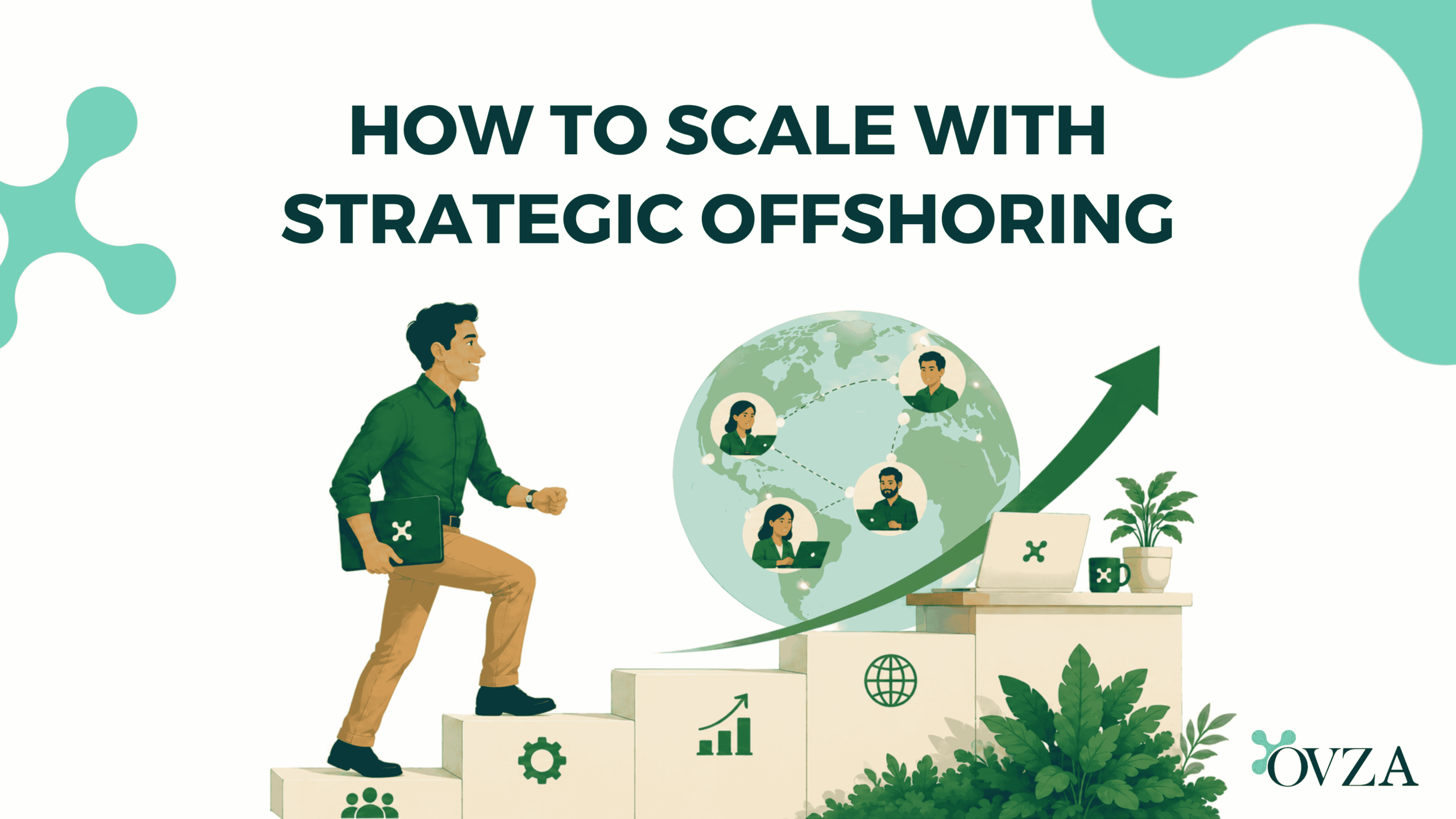
For decades, the term “offshoring” was treated simply as a way to lower costs, shifting back-office administrative tasks to lower-cost jurisdictions purely to minimize operational overhead. It was a model where the primary metric of success was the hourly wage.
Today, traditional outsourcing models are evolving rapidly.
High-growth enterprises are no longer chasing the lowest wage. Instead, they are looking for sustainable solutions to the chronic talent shortages that constrain Western corporate markets.
We have entered a new era of global expansion. The objective has shifted from basic cost-cutting to building highly specialized, legally integrated global teams capable of driving growth with excellent operational agility.
Achieving this level of scale, however, depends entirely on how an organization structures its international corporate footprint.
The Rise of the AI-Augmented Professional
The primary driver of this shift is the integration of advanced technology with global talent. Rather than replacing human capital, automation tools are acting as a powerful efficiency booster for international teams.
In premier global technical hubs, offshore professionals have transitioned from manual operators into systems experts. They are native users of modern AI workflows, automating routine administrative friction like documentation, software testing, and data synthesis.
The New Productivity Paradigm
- Improved Efficiency: An AI-proficient offshore professional can manage a significantly higher operational output by eliminating routine administrative drag.
- Compressed Time-to-Market: When an offshore unit is equipped with a modern, integrated tech stack, development cycles accelerate past local hiring bottlenecks.
- Long-Term Scalability: The true return on investment comes from the systemic productivity and accelerated delivery inherent in a well-supported global team.
Rather than viewing international offices as a line-item expense, forward-thinking organizations treat them as core drivers of business agility and expansion.
From Task-Farming to “Outcome-Led” Pods
Legacy outsourcing models historically relied on “task-farming” , a fragmented process where companies sent static checklists to disconnected third-party vendors. This approach routinely resulted in a loss of context, constant micromanagement, and a lack of true accountability.
Today, international operational standards have shifted toward Outcome-Led Pods.
| Legacy Task-Farming | Modern Outcome-Led Pods |
| Fragmented third-party vendors. | Dedicated, cross-functional units. |
| Measured by hours billed or tickets closed. | Measured by strategic corporate KPIs (e.g., retention, growth). |
| High context loss and frequent vendor turnover. | Retains deep institutional knowledge and long-term stability. |
These modern pods are dedicated, cross-functional units composed of developers, systems architects, and data engineers who maintain total ownership over specific business results. Instead of being compensated for individual tasks completed, these teams are measured against high-level corporate KPIs, such as user retention or platform efficiency.
By focusing on long-term alignment rather than transactional billing, businesses eliminate the friction associated with rotating contractors. This structure fosters deep team stability, transforming the offshore branch into a seamless extension of your parent company.
Global Capability Centers: A Permanent Framework for Growth
To fully capture these operational benefits, mid-sized enterprises are adopting a cornerstone of the Fortune 500 playbook: the Global Capability Center (GCC). This transition marks a fundamental pivot from short-term contracting toward a permanent architecture for international expansion.
A GCC operates as a sophisticated corporate hub, engineered to handle high-value functions such as advanced R&D, proprietary data analytics, and intellectual property development.
The Value of Professional Incorporation
Operating a structured, fully incorporated offshore entity provides distinct advantages over renting talent from external vendors:
- Stronger Global Coordination: Direct management structures ensure your international team is fully aligned with your corporate culture.
- Better Operational Control: Establishing a proprietary entity ensures that your internal data and intellectual property remain protected behind your private corporate firewall.
- Long-Term Scalability: By utilizing formal corporate incorporation, firms secure absolute sovereignty over their operational frameworks, compliance, and future scaling strategy.
Resilience and Geographic Diversification
In a shifting geopolitical and economic landscape, structured offshoring has matured into an essential corporate resilience tactic. Relying exclusively on a single local talent pool represents a concentrated business vulnerability.
By strategically distributing a workforce across multiple corporate jurisdictions, an enterprise creates an operational safety valve against localized inflation, aggressive domestic wage competition, and regional economic volatility.
This geographical distribution is optimized through a “follow-the-sun” operational framework:
- Continuous Momentum: As primary domestic offices close for the evening, properly structured offshore centers in alternative time zones seamlessly assume operational execution.
- Perpetual Productivity: This model leverages global time zones to sustain uninterrupted momentum across critical development and engineering cycles.
- Market Agility: Integrated corporate units bridge the gap between stagnant local hiring environments and a diversified global growth engine.
Conclusion
Strategic offshoring is fundamentally an exercise in structured operational agility. It provides the legal and corporate bridge between localized strategy and cross-border execution. When global entities are fully integrated, appropriately structured, and outcome-oriented, they emerge as a company’s primary driver of scale.
The transition from transactional outsourcing to a high-performance global network requires a solid foundation built on compliant international corporate incorporation and precise structural alignment.
Businesses that combine strong international structuring with global talent strategies will be best positioned for sustainable long-term growth.
At OVZA, we make this transition seamless. We handle the complexities of international incorporation and corporate structuring, allowing you to establish a secure, compliant, and permanent global footprint with total peace of mind.
Disclaimer: The information provided on this website is intended for general reference and educational purposes only. While OVZA makes every effort to ensure accuracy and timeliness, the content should not be considered legal, financial, or tax advice.