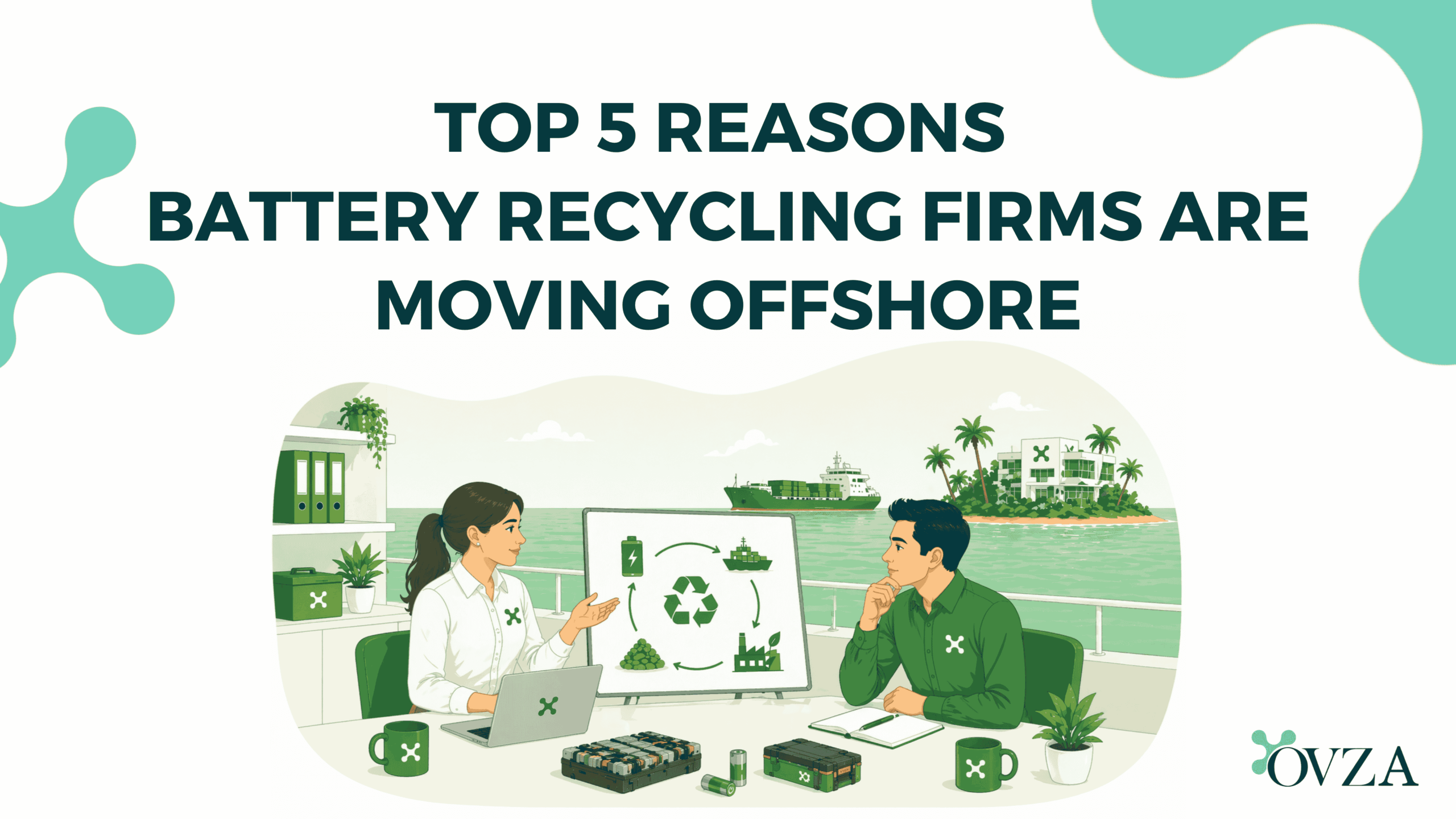
For the firms operating at the cutting edge of this crucial space, the intricate challenge of managing hazardous logistics, navigating aggressive environmental liability, and securing high-value “Black Mass” minerals has necessitated a profound and strategic shift. To robustly protect their core mission and their substantial assets, forward-thinking founders are increasingly pivoting toward Offshore Setups. This move is designed to construct a truly global, resilient operational network that remains firmly and indisputably under their control.
Observing this strategic pivot, we’ve identified the top five reasons why establishing an offshore structure is the defining, most critical move for the modern battery recycling enterprise.
- 1. Strategically Isolating Hazardous Environmental Liability
- 2. Enabling Frictionless Global Trading of "Black Mass" Minerals
- 3. The Sovereign IP Vault: Protecting Second-Life AI
- 4. Scaling with Global Institutional ESG Capital
- 5. Managing "Digital Battery Passport" Compliance
- The Strategic Shift: Why Infrastructure Decoupling Matters
- Comparison: Local Practice vs. Global Circular Hub (2026)
- Conclusion
1. Strategically Isolating Hazardous Environmental Liability
Recycling batteries is inherently high-risk, especially with the 2026 “Strict Liability” standards. One incident can easily spiral into a lawsuit capable of sinking an entire enterprise. To prevent a localized accident from reaching the parent company’s core balance sheet, we utilize a “ring-fencing” strategy. By housing each facility within its own offshore Special Purpose Vehicle (SPV), we create a legal firewall. This ensures that environmental liabilities remain isolated to the specific site, keeping the broader company’s R&D, manufacturing, and global assets insulated from catastrophic financial contagion.
2. Enabling Frictionless Global Trading of “Black Mass” Minerals
While black mass is the essential feedstock for the EV era, 2026 has seen a sharp rise in export restrictions aimed at fostering “national self-sufficiency.” These caps often force companies to sell locally at a discount. To bypass these hurdles, many firms now leverage offshore holding structures to secure mineral titles.
This maneuver creates a legal path to international markets, allowing sellers to sidestep regional trade barriers and offload inventory at premium spot prices in global industrial hubs. It’s a necessary pivot for anyone looking to optimize global ROI in a restricted market.
3. The Sovereign IP Vault: Protecting Second-Life AI
The key profit opportunity for 2026 is “Second-Life” Repurposing, a sophisticated process using proprietary AI to digitally diagnose used batteries and project their remaining utility for new applications.
To safeguard this proprietary “Digital Brain,” we strategically house the diagnostic algorithms’ patents and “Model Weights” offshore. This move leverages strong Statutory Privacy laws, creating a legal firewall to prevent local governments from demanding access to our sensitive source code for forced technology transfers or inspections. Securing these mission-critical digital assets in a neutral, high-security legal environment ensures absolute control over our core intelligence, shielding our competitive advantage from both aggressive competitors and overreaching regulators.
4. Scaling with Global Institutional ESG Capital
Big-time investors who care about the environment are pouring money into battery recycling. But they won’t hand over the big checks unless they see a stable, reliable setup that isn’t easily swayed by political changes in one country.
By setting up a holding company somewhere neutral, businesses can create a clear and trustworthy ownership structure. This professional approach to ownership gives global financiers the strong corporate oversight and legal certainty they need before they commit to long-term deals.
Simply put, this structure makes it much easier to get the huge infrastructure loans needed to build those massive, million-ton recycling plants that can serve several countries at once.
5. Managing “Digital Battery Passport” Compliance
By 2026, every battery sold will require a “life story,” detailing its origin and composition. To streamline this process globally, a single, centralized offshore data hub has been established. This hub acts as a global librarian, managing all data flow and eliminating the need for companies to deal with complex, country-specific compliance paperwork.This system tracks and verifies the recycling of minerals, issuing a “Passport” for instant entry into strict markets like the EU. The goal is a single, simple report regardless of location.
The Strategic Shift: Why Infrastructure Decoupling Matters
It is essential to recognize that the 2026 battery recycling landscape has shifted from a local waste-management issue to a high-stakes global commodity play.
As resource nationalism tightens its grip on critical minerals and domestic environmental liabilities become increasingly aggressive, firms are finding that a “domestic-only” structure often acts as a bottleneck for growth.
By decoupling physical processing from strategic asset ownership through an offshore setup, operators can ensure that their capital, intellectual property, and mineral titles are shielded from regional volatility, allowing them to scale at the true speed of the global clean energy transition.
Comparison: Local Practice vs. Global Circular Hub (2026)
| Feature | Local Recycling Setup | Global Offshore Hub |
| Liability Profile | Parent company fully exposed | Isolated via individual SPVs |
| Mineral Trading | Subject to regional export caps | Global Mobility (Unrestricted) |
| IP Protection | Vulnerable to forced disclosure | Sovereign IP Vault |
| Capital Access | Limited to domestic lenders | Global Institutional Capital |
| Compliance | Fragmented across borders | Centralized Passport Management |
Conclusion
Moving from just recycling in your neighborhood to becoming a major player in the global circular economy is the big focus for industry leaders this year. When you set up the right international business structure, it’s not just about easier paperwork. It’s about building a strong, reliable core that keeps your company’s value safe while helping you grow everywhere. The smartest business owners understand that while the high-quality materials they produce are their product, a solid corporate setup is the real vehicle that gets those materials delivered to customers all over the world.
Disclaimer: The information provided on this website is intended for general reference and educational purposes only. While OVZA makes every effort to ensure accuracy and timeliness, the content should not be considered legal, financial, or tax advice.